
Nextekci - Back to the home page
Language
FREN
Site appearance
Theme (colours)
Background

NEXTEKCI School

The poultry farming encyclopedia

57 articles to understand poultry farming in Côte d’Ivoire and West Africa: species, equipment, feed raw materials, trades and the industry. Free, in English and French.

Species and breeds

Broilers, coloured chickens, laying hens, village chickens, guinea fowl, ducks, turkeys, quails… what you need to know about each poultry species raised in West Africa.

12 articles
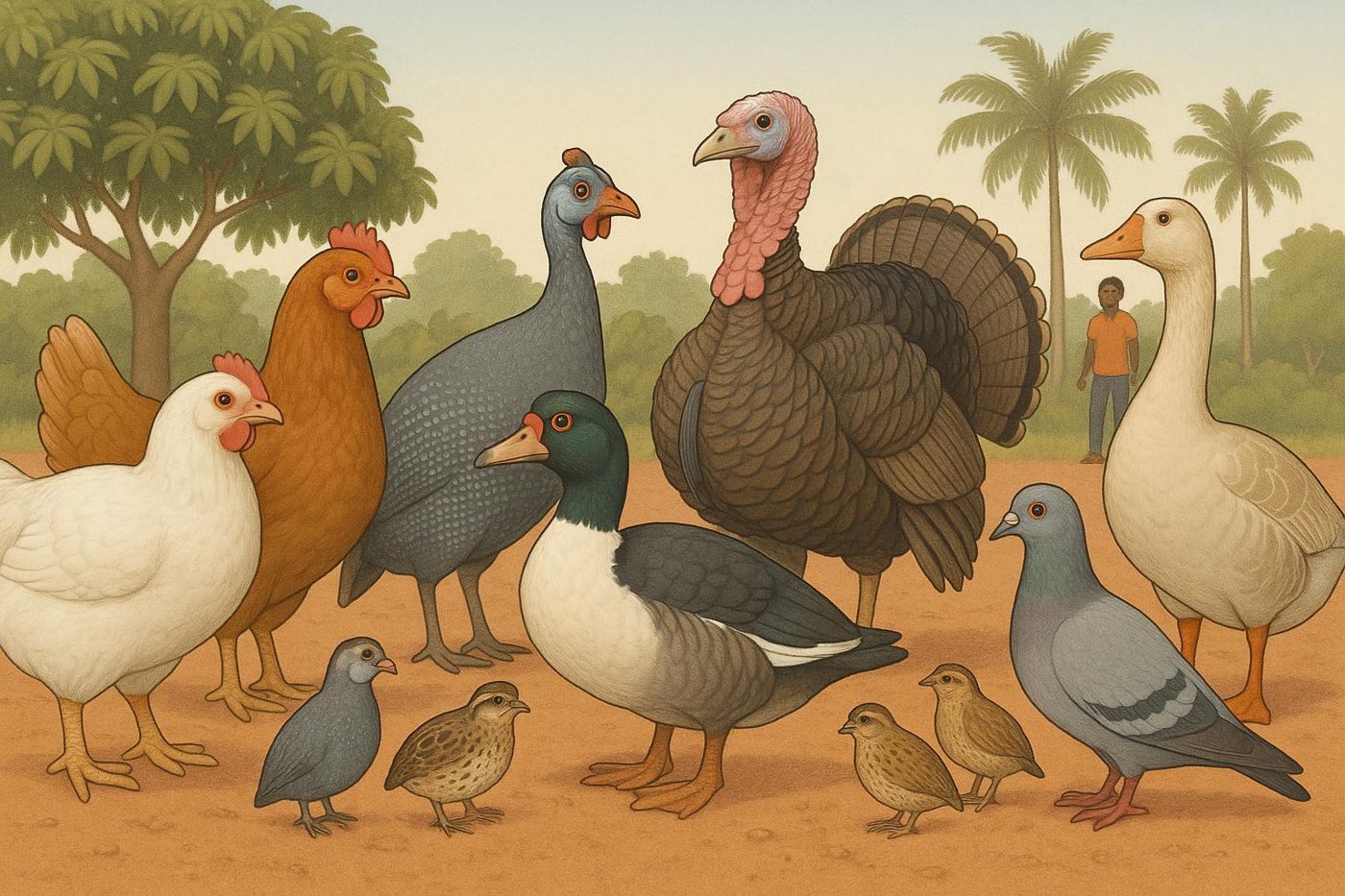
Species and breeds
The white broilerThe white broiler is the fast-growing chicken, raised only for its meat and sold at around 35 to 45 days. It is the fastest business in poultry farming, but also the most demanding: a well-run house, complete feed and a buyer ready on the day of sale.Coloured and hybrid chickensRed broilers, barred grey, naked-neck hybrids: coloured chickens grow more slowly than white broilers, but they are hardy, cope better with heat and give firm meat close to that of village chickens. They are sold between 8 and 14 weeks, when the farmer chooses.The brown layerThe brown layer is a hen selected to lay brown-shelled eggs over about a year and a half of production. It is a long-term investment: several months of rearing the pullet with no income, then eggs almost every day.The white cockerelThe white cockerel is the young male of a laying-type strain, raised for its meat and sold young. Lighter than a broiler, it sells easily at markets and is an affordable way into the trade while you learn.The Ivorian village chicken (“bicycle chicken”)The “bicycle chicken”, or village chicken, is the local chicken that roams freely around homes. Hardy and valued for its firm meat, it grows slowly and suffers heavy losses. Yet a few simple steps are enough to improve this small-scale farming significantly.The guinea fowlNative to Africa, the guinea fowl is a hardy, noisy and watchful bird, valued for its strongly flavoured meat. Common in northern Côte d’Ivoire and the Sahel countries, it needs special care during its first weeks.The duck (Muscovy and common duck)Two ducks are raised in West Africa: the Muscovy, hardy and quiet, very common in villages, and the common duck, which matures earlier. Both give popular meat and are easy to raise, provided water and litter are well managed.The turkeyThe turkey is the largest of the common poultry species, raised for its meat and in high demand at the end-of-year holidays. Rearing it requires patience at the start, space, good protection from heat and strict separation from chickens.The quailThe Japanese quail is a very small, early-maturing bird raised for its small speckled eggs and its meat. It needs little space and produces quickly, but its market is narrow: find your customers before you start.The gooseThe goose is a large bird that feeds largely on grass. Rarely raised in Côte d’Ivoire, it remains a curiosity, but it is hardy, long-lived and keeps a noisy watch over the farm.The pigeon (raising pigeons for meat)Meat pigeons are raised for their squabs, sold young for their tender meat. The farm relies on stable pairs, housed in a healthy loft, that feed their young themselves. It is a niche production that needs little space.The ostrichThe ostrich, the largest living bird, is native to Africa. It is farmed for its lean red meat, leather, feathers and eggs. It is a specialised enterprise requiring large enclosures, heavy investment and a great deal of patience.

Farm equipment

Drinkers, feeders, brooders, incubators, scales, footbaths… what each piece of equipment is for, how many you need, how to set it up and maintain it.

18 articles
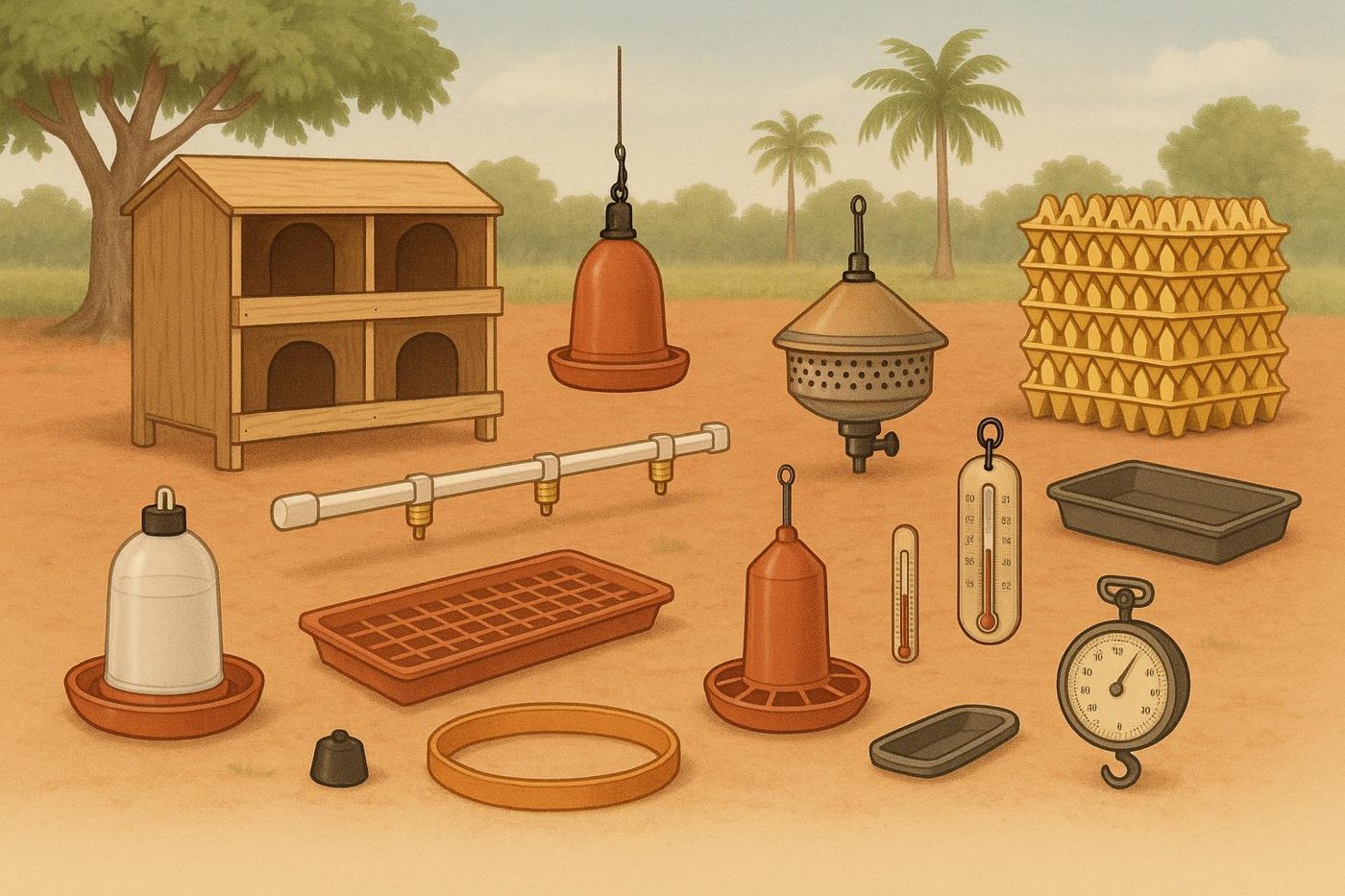
Farm equipment
Siphon drinker (chick drinker)A small drinker that sits on the litter and is filled by hand, giving chicks their water during the first days. You need 14 to 16 per 1,000 chicks, kept clean, filled with water at room temperature and never placed under the heat source.Bell drinker (hanging drinker)A hanging drinker, connected to the tank by a pipe, which keeps its own water level. Allow one bell for 80 to 100 birds, with the rim at back height, weighted and washed every day.Nipple drinkers and drinker linesSmall valves fitted to a pipe: the bird touches the pin and receives a drop of water. As a closed system, the water stays clean and the litter drier. Allow about 10 to 12 broilers per nipple, and 1 nipple for 10 hens at 30 °C.Chick feeder tray (tray, egg flat, paper)Trays, lids, upturned egg flats or paper laid on the litter: this is where the chick learns to eat, by pecking at what it sees. One tray for 50 chicks, paper over at least half of the brooding area, for the first 7 to 10 days.Hanging feeder (tube feeder and pan)A reservoir hanging above a pan, filled by hand, from which feed flows down as the birds eat. One 10 to 15 kg tube feeder for 40 to 50 broilers, rim at back height, never empty and never filled to the brim.Automatic feeding (chain and pan systems)Systems in which a motor carries feed from a hopper or silo to the birds, in a trough (chain) or in pans. At least 2.5 cm of trough per bird for a chain, 60 to 70 broilers per pan. They depend on electricity.Gas brooder (radiant heater)A heater hung above the chicks that warms the litter by radiation. It is the reference heat source for brooding: stable, adjustable and independent of mains power. About 40 °C at floor level directly beneath it, at least 32 °C in the rest of the brooding area.Charcoal and other heat sources for broodingCharcoal and infrared lamps are widely used to keep chicks warm. They work provided a few safety rules are followed: charcoal only in a closed stove, away from the litter, with the fumes vented; lamps only with a back-up power supply.Chick guard (brooder ring)A ring of cardboard, metal sheet or tarpaulin set around the heat source, keeping chicks close to heat, water and feed. 40 to 60 cm high, 2.5 to 3 m across for 300 to 500 chicks, enlarged every day and removed at about 7 to 10 days.Thermometer and thermo-hygrometerSmall instruments that measure air temperature and humidity at bird height, day and night. A min-max thermometer tells you what happened during the night. Essential during brooding, they are always read with the chicks in view.Weighing scaleA hanging or platform scale, with a bucket or net, used to weigh a sample of birds every week. It lets you compare growth with the targets, calculate flock uniformity and spot a delay before it becomes costly.Footbath and disinfection equipmentA footbath is a tray of disinfectant at the entrance to every house, where boots are dipped on the way in and on the way out. Together with dedicated boots and clothing, hand washing and a sprayer, it makes up the small kit that keeps germs out.Curtains and tarpaulins for open-sided housesIn an open-sided house, the wind does the ventilating and the curtains control it. Properly fitted, without leaks, and adjusted several times a day, they keep birds cool by day and protect chicks from cold and draughts at night.Poultry house lighting (bulbs and lighting programme)Lighting helps chicks find water and feed, then governs the birds’ activity and, in layers, egg production. About 25 lux during brooding, evenly spread light with no dark corners, a reliable timer and a back-up power supply.Nest boxes and perches for layersNest boxes give hens a dark, quiet place to lay clean eggs; perches let them sleep off the ground. One individual nest for 5 to 6 hens, 40 to 50 cm off the floor, in place before the pullets arrive.Egg trays and egg storageMoulded egg trays protect eggs between the nest and the customer, and a cool, shaded store keeps them fresh. Eggs are sorted at every collection, set point down, dated, kept cool and sold within the week, oldest first.Incubator: how it works and precautionsAn incubator recreates, for 21 days, the conditions a broody hen provides: warmth, humidity and egg turning. It is a demanding machine that needs a stable power supply, strict hygiene and settings followed to the letter.Generator and water reserveThe farm’s two insurances against breakdowns: a water reserve covering at least 48 hours of peak consumption, and a back-up power supply for heat, light and the pump. A plan B that has never been tested does not exist.

Feed raw materials

Maize, oilseed meals, brans, fish meal, shells, premix… the role of each ingredient, its strengths, its limits and how to check it.

15 articles
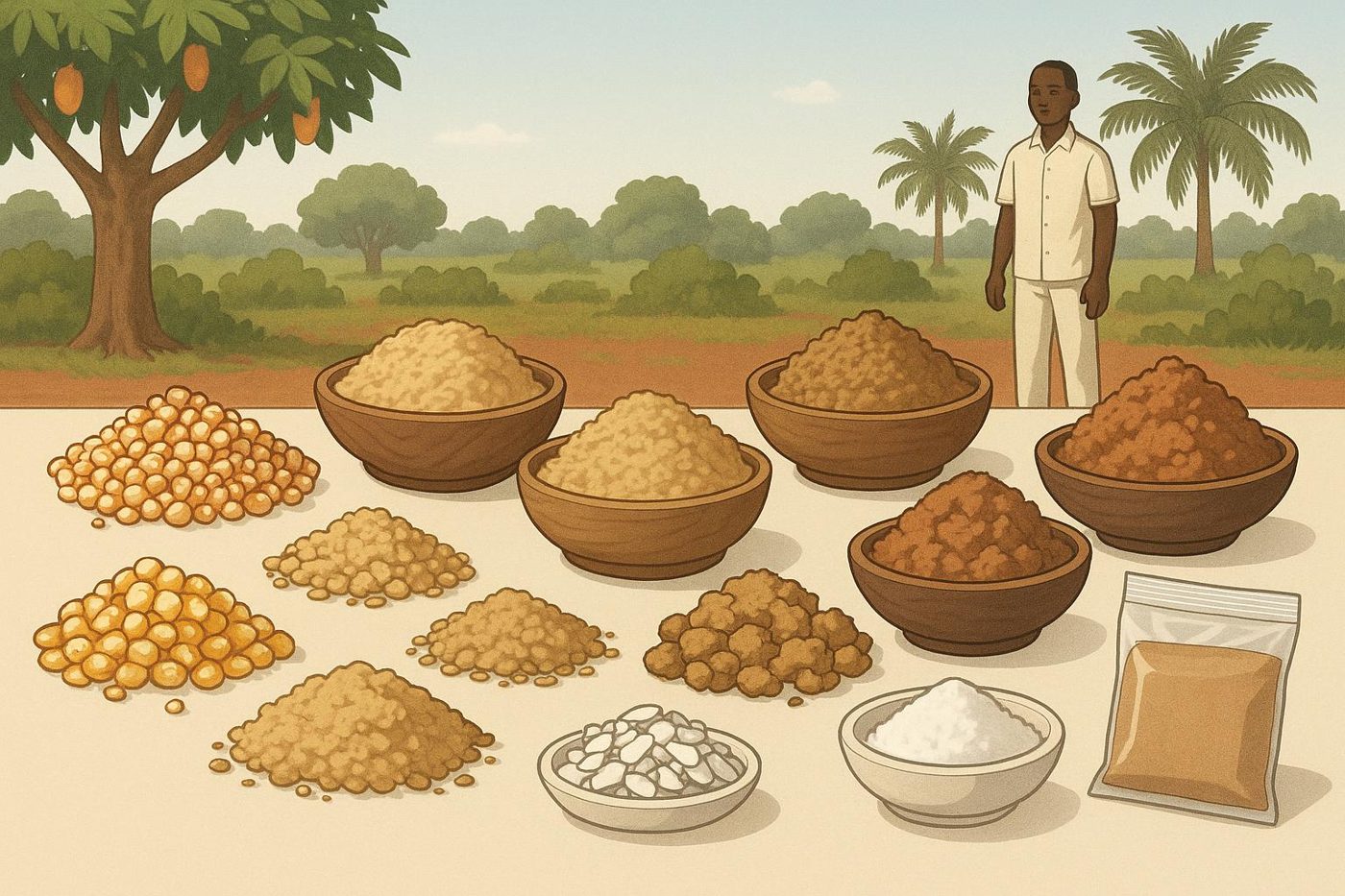
Feed raw materials
MaizeMaize is the basic cereal in most poultry feeds: it supplies most of the energy. It is poor in protein, minerals and vitamins, and it fears moisture: badly dried or badly stored maize picks up moulds and aflatoxins.Sorghum and milletSorghum and millet are dry-zone cereals that can replace part of the maize as an energy source. They do not colour the egg yolk or the skin, and some sorghums contain tannins that reduce digestion. Their use is decided in the formula, not by guesswork.Wheat branWheat bran is the outer layer of the grain, recovered by flour mills when they make flour. It provides a little protein and a lot of fibre, but little energy for poultry. Useful in some feeds, it must never be used to "stretch" a broiler feed.Rice bran and broken riceRice gives two products that are useful for poultry: broken rice, an energy cereal close to maize, and rice bran, rich in oil but quick to go rancid, whose quality depends on how much husk it contains. Rice husk itself does not feed.Soybean mealSoybean meal is the main source of protein in poultry feeds. Its protein is the best balanced of all plant proteins and rich in lysine. It must have been properly heated: raw or undercooked soya contains factors that block digestion.Cottonseed mealCottonseed meal is a protein source produced in cotton-growing areas, notably in the north of Côte d’Ivoire. It is useful but limited: it contains gossypol, a substance that slows growth and discolours eggs, and its protein lacks lysine. It is used in measured amounts, decided by the nutritionist.Groundnut meal and the aflatoxin riskGroundnut meal is rich in protein and very palatable, but it is the raw material most exposed to aflatoxins, poisons produced by moulds. A contaminated batch can ruin a flock without any visible mould. It is only used once checked, and in amounts set by the nutritionist.Fish mealFish meal is an animal protein source of very high value, rich in lysine and methionine, calcium and phosphorus. But its quality varies enormously: salt, sand, rancidity and germs are the traps of badly made meals. It is used in small amounts, within a formula.Shells and limestone: calciumLimestone and crushed shells are the calcium sources in feed. The layer needs large amounts to make her eggshells; the chick and the broiler need much less. Too early or too much damages the kidneys; too little gives fragile shells and weak bones.Dicalcium phosphateDicalcium phosphate supplies the phosphorus that cereals and oilseed meals provide poorly, plus some calcium. Without enough phosphorus, bones stay soft and legs weaken. It must be of a grade intended for animal feed, with the fluorine removed.SaltSalt supplies sodium and chloride, which are essential in small amounts for appetite, growth and the body’s water balance. Too little, and birds eat less and may start pecking; too much, and they drink too much, the litter gets wet, and chicks can be poisoned.Premix: vitamins and trace mineralsA premix is a concentrated blend of vitamins and trace minerals added to the feed in small amounts. Small in volume, it is essential: without it, even a feed rich in maize and soya gives birds that grow badly, have leg problems or lay badly. It is fragile and must be stored with care.Cassava (dried chips) and its limitsCassava, plentiful in Côte d’Ivoire, is rich in starch and can provide energy in place of part of the maize. But it contains almost no protein, does not colour, and must be peeled and well dried to reduce its toxic compounds. It never replaces maize without redoing the whole formula.Synthetic amino acids: lysine and methionineProteins are made of amino acids. In a maize and soya feed, methionine and lysine are the first to run short. Synthetic amino acids make it possible to top them up precisely, balance the feed and limit excess protein. They are weighed to the gram, within a formula.Water, the first nutrientWater is the bird’s first nutrient: it makes up 65 to 78% of its body, and the bird drinks about twice as much as it eats in feed, far more in hot weather. A bird that drinks badly eats badly. Water must be clean, cool and available at all times.

Trades and the poultry industry

Farmer, technician, veterinarian, hatchery, feed miller, slaughterhouse, trader… and how the poultry industry works in Côte d’Ivoire and West Africa.

12 articles
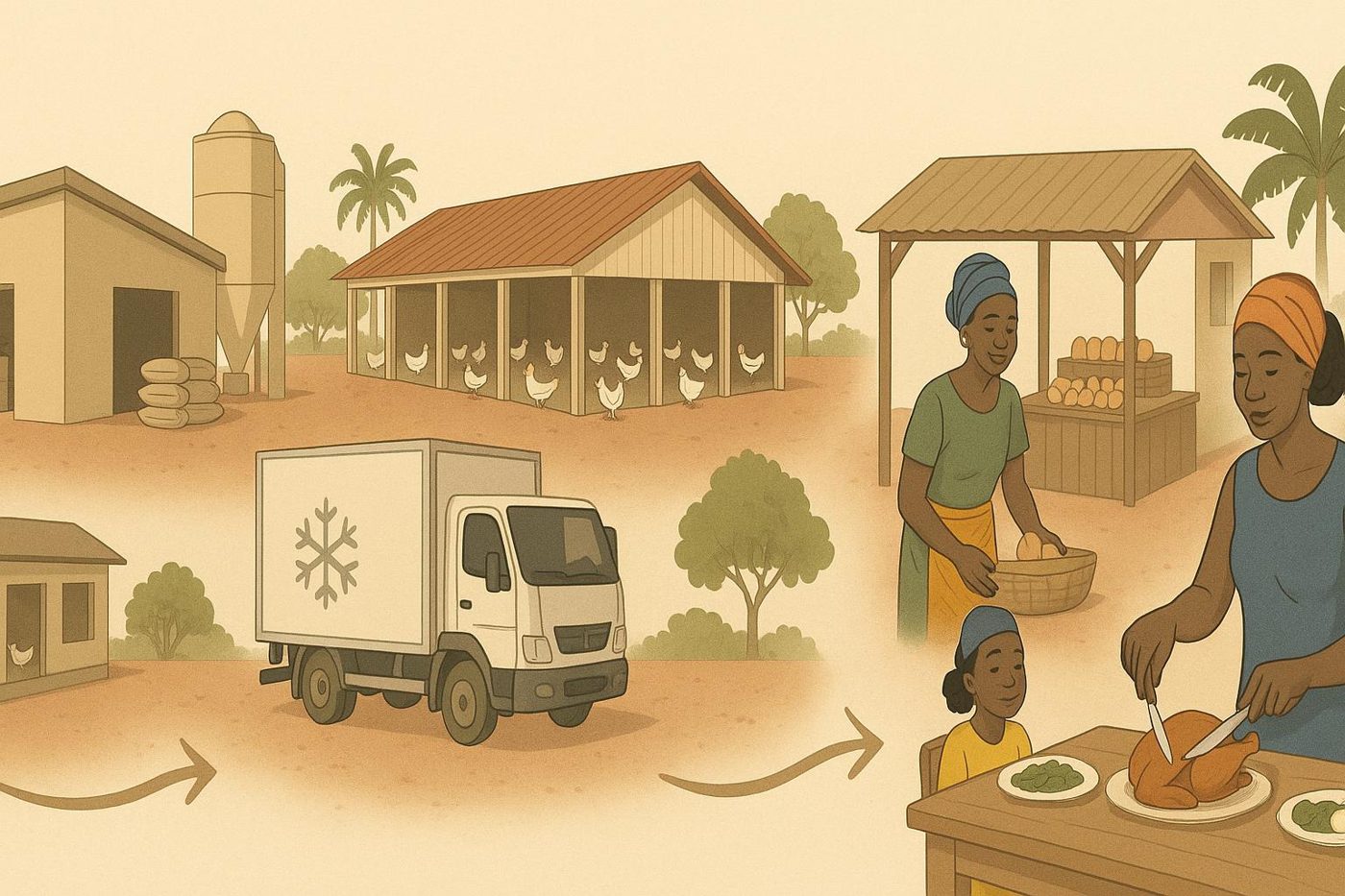
Trades and the poultry industry
The poultry farmer as entrepreneurA poultry farmer is both the technician of his birds and the head of a small business. He buys chicks and feed, manages his flocks, keeps his accounts and sells what he produces. Success depends as much on daily discipline as on sound business decisions.The poultry technicianThe poultry technician advises farmers on how to run their flocks: housing, brooding, feeding, watering, hygiene and performance monitoring. He bridges theory and the field, without replacing the vet for diagnosing and treating diseases.The vet and the animal health assistantThe vet is the only person authorised to make a diagnosis, prescribe treatment and set a vaccination protocol suited to the area. The animal health assistant, trained in basic tasks, supports the vet close to the farms. Together, they protect the health of the birds and of consumers.The hatchery: the work of hatchingThe hatchery turns hatching eggs into day-old chicks. Receiving and storing eggs, incubation, hatching, grading and preparing chicks: each step requires precision, hygiene and consistency, because chick quality shapes the whole life of the flock.The feed millerThe feed miller produces compound feeds for poultry. He selects the raw materials, designs formulas suited to each type of bird and each growth phase, and guarantees a consistent, safe mix. Since feed is a farm’s biggest expense, the quality of his work directly affects farmers’ success.The slaughterhouse and the cold chainThe slaughterhouse turns live birds into meat fit for consumption, under controlled hygiene conditions. The cold chain then takes over to preserve the meat all the way to the consumer. It is the link that most directly protects public health.The poultry traderThe trader links farms and consumers. He buys birds or eggs from farmers and sells them on markets, to restaurants or to households. He knows demand, peak periods and customer expectations, which makes him a valuable partner for the farmer.The chick carrierThe chick carrier takes day-old chicks from the hatchery to farmers. The job is short but decisive: a chick that has been too hot, too cold or thirsty during the journey starts badly, and the setback is felt throughout the flock’s life.How the poultry sector works in Côte d’IvoireThe Ivorian poultry sector is a chain of trades that depend on one another: hatcheries, feed mills, farms, slaughterhouses, traders and consumers. It is supported by the IPRAVI inter-professional body and supervised by the State veterinary services.Poultry farming in West AfricaIn West Africa, poultry farming ranges from the family backyard to modern housed farms. It faces shared challenges (feed costs, heat, disease, cold chain) but offers real opportunities, driven by continuing strong demand for animal protein.Starting in poultry farming: the stepsA successful start in poultry farming takes preparation: defining the project, choosing the land, building a suitable house, finding finance and getting trained before the first flock arrives. Starting small and learning from each flock remains the safest path.Biosecurity and regulations: what a farmer should knowA farm is not isolated: its diseases can reach neighbouring farms and its products end up on consumers’ plates. Biosecurity protects the farm, and a few rules frame the activity: notifiable diseases, approval of establishments, traceability. When in doubt, the veterinary services and the vet in your area are the right people to ask.
Chat with Maria, your AI assistant