
Poultry encyclopedia · NEXTEKCI School · Species and breeds
The Ivorian village chicken (“bicycle chicken”)
The “bicycle chicken”, or village chicken, is the local chicken that roams freely around homes. Hardy and valued for its firm meat, it grows slowly and suffers heavy losses. Yet a few simple steps are enough to improve this small-scale farming significantly.
Key facts
- Common names
- Bicycle chicken, village chicken, local chicken
- System
- Free-roaming around homes
- Growth
- Slow
- Reproduction
- Natural brooding by the hen (21-day incubation)
- Strengths
- Hardiness, firm meat, low costs
- Weakness
- Heavy chick losses (disease, predators)
What is the bicycle chicken?
In Côte d’Ivoire, the “bicycle chicken” is the local chicken raised free-range in villages and yards. Its name is said to come from its slender shape, long legs and firm meat, the very opposite of the fast-growing broiler.
It is not a single breed but a very varied population: plumage of every colour, naked necks, feathered legs. This diversity, shaped by generations of outdoor life, gives it its hardiness.
Uses and place in society
Its firm, tasty meat is much sought after for festive meals, ceremonies and gifts. For many rural families, chickens are also savings on legs, sold when money is needed.
The eggs are mainly used to renew the flock through brooding. Table-egg production remains low: the hen lays few eggs and stops to sit and raise her chicks.
The traditional system
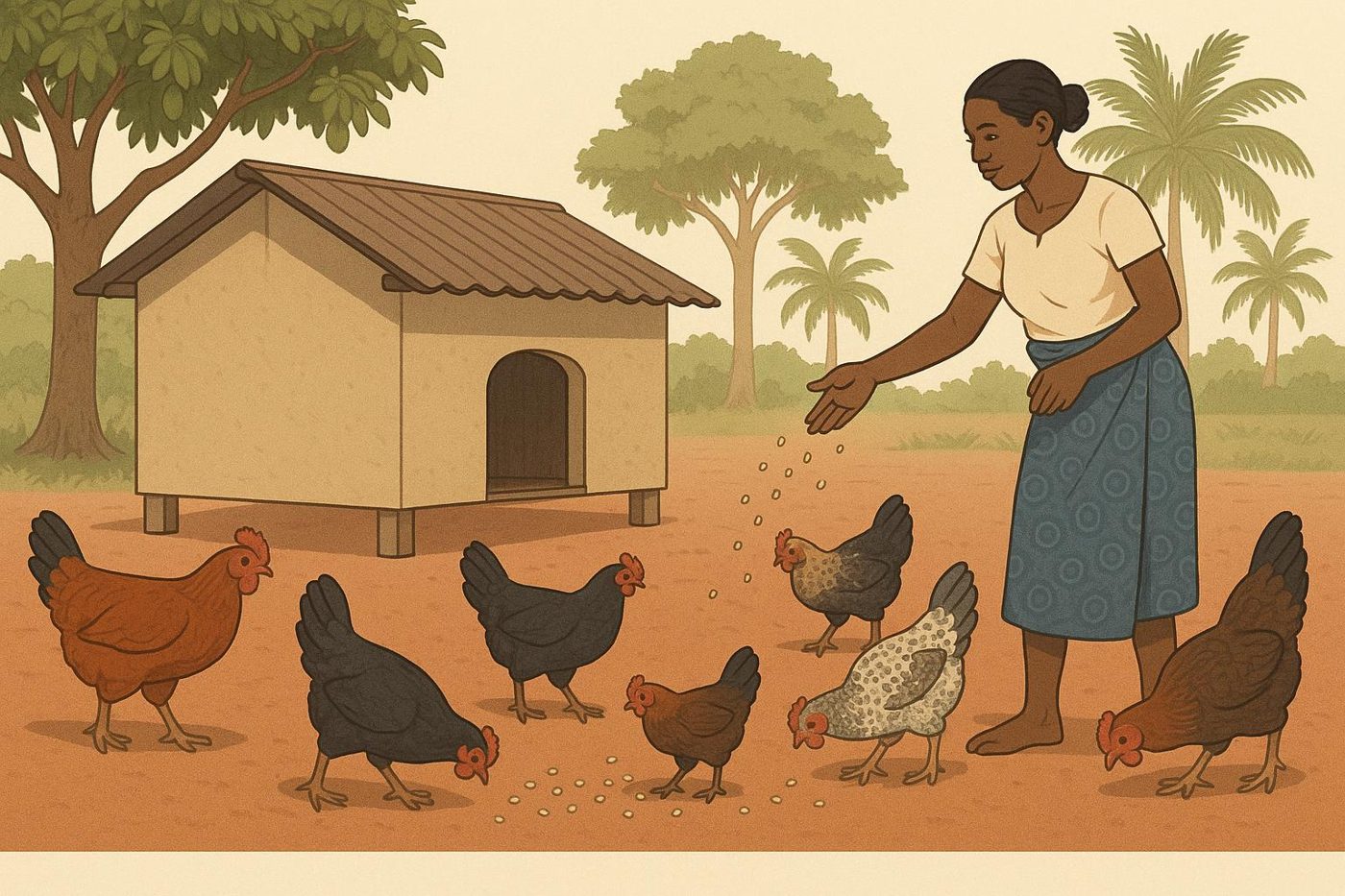
The chickens roam all day and find most of their food: seeds, kitchen scraps, insects, greens. They are sometimes given a little grain and go back in the evening to a basic shelter or into the trees.
This system costs very little, but losses are heavy, especially among chicks: birds of prey, snakes, dogs, cats, cold and rain, and above all disease. Newcastle disease can wipe out a large share of a village’s chickens within a few days.
Improving traditional rearing
A clean, dry, closed night shelter protects against predators and rain. During the first weeks, keeping the hen and her chicks in a cage or small pen greatly reduces losses. Clean water every day and some supplementary feed, especially for chicks, speed up growth.
Vaccination against Newcastle disease is the step that saves the most chickens: organise it with the vet or livestock officer in your area, along with deworming. Keep your best broody hens and remove sick or stunted birds.
Moving to improved rearing
To produce more while keeping the firm meat customers like, many farmers move to hardy coloured chickens (red broilers, barred grey, hybrids), which look like village chickens but grow much faster, indoors or with a protected run.
Beware: free-roaming village chickens can carry disease. They must never come near a flock of broilers, coloured chickens or layers.