
Weighing to Manage

Lesson text
Your chickens look good, the flock seems to be doing well. But a hundred grams of delay is not visible to the eye.
When the delay finally becomes apparent, it has already cost days. The scale shows it from the week it starts.
Weighing is not for filling a record book. It’s to decide what to change, and when.
I recommend weighing at least thirty. Below that, an average can mislead you.
Close off a small pen at random, and weigh everything it contains, without choosing. The easiest to catch do not resemble the flock.
Do this in several places, away from doors and walls. A single corner of the building does not represent the entire flock.
And always at the same time, with the same scale. A chicken that has just eaten weighs more than when it wakes up.
Weigh them one by one, not in a pile. Weighing in a pile gives an average, never the variation between them.
Then compare your average to the breed benchmark. A little over a kilo at three weeks, nearly two kilos three at five weeks.
This benchmark assumes good conditions. Under our heat, you will often be a bit below.
What matters is the deviation from the benchmark. If it grows from one week to the next, the curve drops.
The second reading is the uniformity of the flock. Count those who are within ten percent of the average.
For an average of one kilo, that’s all chickens between nine hundred and one thousand one hundred grams.
Twenty-four out of thirty or more, the flock is uniform. Twenty-one, it is average. Eighteen, it is dispersing.
The gap widens especially between ten and twenty-four days. Seeing it early helps avoid a tail end of the flock.
And if the curve drops? Above all, immediately reweigh another group, elsewhere. If the second weighing confirms, investigate.
First, check the water. Too low pressure or water that is too warm, and the chicken drinks less, thus grows less.
Next, the space at the feeder. When it is lacking, the smallest drop out first.
Then the heat. A chicken that pants eats less, and its curve flattens.
Finally, the feed. A change in bag or formula is often reflected on the scale the following week.
And at your place, does the scale come out every week, or only on the day the buyer arrives?
Send your thirty weights along with the age of the flock via WhatsApp, to 05 44 83 27 79, for information. You will receive the flock record book, free of charge.
Your orders for chicks go through 07 07 72 78 67. Subscribe, and we will see the last days before the sale.
Your broiler chicks hatch with us, in Agnibilékrou. With Nextekci, every customer is a satisfied farmer.
 The Flock's Waiting LineNEXTEKCI · Lesson 22
 The flock that drops a week before it showsNEXTEKCI · Lesson 33
 Correct weight, vanished feed: the invisible leakNEXTEKCI · Lesson 44
 When hens attack each otherNEXTEKCI · Lesson 55
 Torticollis and sudden deaths: the Newcastle signalNEXTEKCI · Lesson 66
 The vaccine given in chlorinated water protects no oneNEXTEKCI · Lesson 77
 The tail of the flockNEXTEKCI · Lesson 88
 Sell by the kilo, not by the headNEXTEKCI · Lesson 99
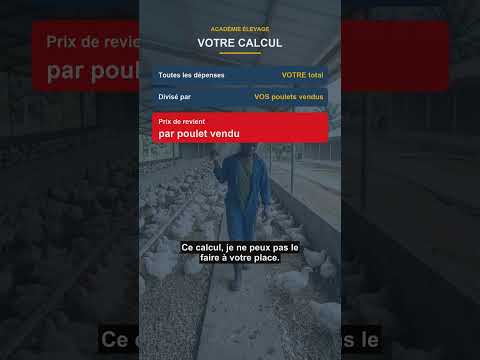 The cost price of a chickenNEXTEKCI · Lesson 1010
 The extra kilo of feedNEXTEKCI · Lesson 11▶
 Weighing to ManageNEXTEKCI · Lesson 1212
 The last days before saleNEXTEKCI · Lesson 1313
 The worst place to saveNEXTEKCI · Lesson 1414
 Homemade feedNEXTEKCI · Lesson 1515
 The feed storeNEXTEKCI · Lesson 1616
 Changing feedNEXTEKCI · Lesson 1717
 The feeder, where the feed goesNEXTEKCI · Lesson 1818
 The Morning DroppingsNEXTEKCI · Lesson 1919
 When deaths increaseNEXTEKCI · Lesson 20
Other lists
 5 videosThe big betMini-drama · 5 episodesPlay the list
 3 videosThe maquis contractMini-drama · 3 episodesPlay the list
 2 videosThe farmer's notebook — complete seasonsMini-drama · 2 episodesPlay the list
 9 videosRosine's notebookMini-drama · 9 episodesPlay the list
 5 videosThe boss lady's planMini-drama · 5 episodesPlay the list
 20 videosMariam's dowryMini-drama · 20 episodesPlay the list
 9 videosChick moneyMini-drama · 9 episodesPlay the list
 3 videosTrue storiesMini-drama · 3 episodesPlay the list
 1 videosStubborn UncleMini-drama · 1 episodePlay the list
 221 videosTips of the day221 short videos · most recent firstPlay the list
 31 videosPractical questions31 short answers · ordering, collection, towns…Play the list