
What would you like to watch? Tap a category.
The NEXTEKCI Academy
The founder’s lessons, in the order of the programme. Start with the first one: at the end of each video, the next one starts by itself.
The extra kilo of feed
 Presented by Abdul Hussein ChoumanFounder of NEXTEKCI · Agnibilékrou hatchery since 2006

Lesson text
You open the last bag intended for the flock. And your chickens do not yet have the weight.
You need to buy more bags. But where has the feed gone? To find out, one number is enough.
This number has a name, the feed conversion ratio. The feed consumed, divided by the weight of chicken produced.
It indicates how much feed is required for one kilo of chicken. The lower it is, the better your feed performs.
For a chicken weighing one kilo eight, the standard of the breed requires just under two and a half kilos of feed.
In Côte d'Ivoire, we rather observe three and a half kilos. One kilo more, without an extra gram of meat.
For a thousand chickens, that amounts to a tonne. Twenty bags of fifty kilos, lost for the meat.
Put the price of your bag against these twenty bags. No buyer will pay you for that kilo.
This kilo leaks through six holes. I will show you each one. Each can be blocked at your place.
First leak, the feed. A formula rich in protein guarantees nothing if the useful amino acids are lacking.
Second leak, the heat. When it pants, its growth drops faster than its appetite.
Third leak, the waste. A feeder too full, or placed too low, and part of the feed ends up in the litter.
What falls to the ground counts in your bags, never in your kilos sold.
Fourth leak, a failed start. A delay taken in the first week costs at sale, in extra days of feed.
Fifth leak, the duration. At seven days, the breed's ratio remains below one. At forty-two days, it exceeds one and a half.
Between thirty-five and forty-two days, each kilo gained requires nearly two kilos of feed. This is where the tail end of the flock hurts the most.
Sixth leak, the heterogeneous batch. The smaller ones stay longer in the chicken coop, and eat for fewer kilos at sale.
Each of these leaks has its own lesson in this series. And above all, they add up on the same flock.
Your ratio is calculated with two numbers. The empty bags of the flock, and the kilos sold.
Sold by head without a scale, the second number is missing. Another reason to sell by the kilo.
And at your place, how many bags for a hundred chickens sold? Have you already counted it, flock after flock?
Calculate your ratio and send it to us. Our WhatsApp information is 05 44 83 27 79. The flock record book provided keeps track of your bags and your kilos.
Orders for chicks at 07 07 72 78 67. Subscribe, we will then learn to weigh for management.
Six qualities of day-old chicks, here in Agnibilékrou. With Nextekci, every customer is a satisfied poultry farmer.
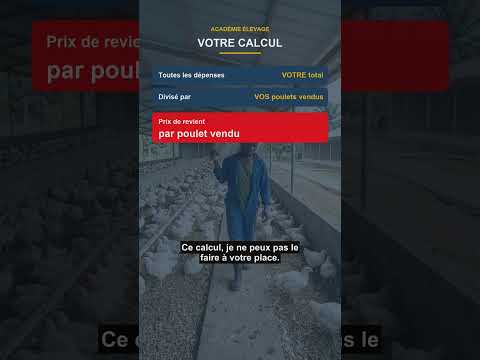 The cost price of a chickenNEXTEKCI · Lesson 10▶
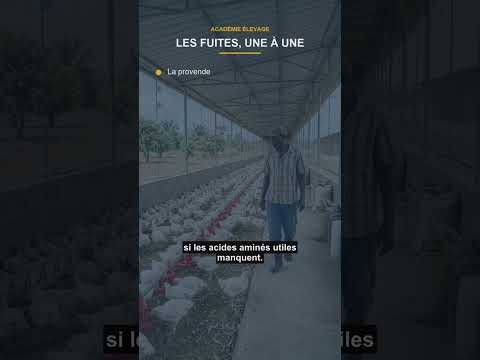 The extra kilo of feedNEXTEKCI · Lesson 113
 Weighing to ManageNEXTEKCI · Lesson 124
 The last days before saleNEXTEKCI · Lesson 135
 The worst place to saveNEXTEKCI · Lesson 146
 Homemade feedNEXTEKCI · Lesson 157
 The feed storeNEXTEKCI · Lesson 168
 The feed storeNEXTEKCI · Lesson 169
 Changing feedNEXTEKCI · Lesson 1710
 Changing feedNEXTEKCI · Lesson 1711
 The feeder, where the feed goesNEXTEKCI · Lesson 1812
 The Morning DroppingsNEXTEKCI · Lesson 1913
 When deaths increaseNEXTEKCI · Lesson 2014
 When deaths increaseNEXTEKCI · Lesson 2015
 Heat, in the right orderNEXTEKCI · Lesson 2116
 Heat, in the right orderNEXTEKCI · Lesson 2117
 Litter, the chain that starts from a leakNEXTEKCI · Lesson 2218
 Litter, the chain that starts with a leakNEXTEKCI · Lesson 2219
 Close the night without suffocating the flockNEXTEKCI · Lesson 2320
 Closing up at night without suffocating the flockNEXTEKCI · Lesson 2321
 The water line, from the insideNEXTEKCI · Lesson 2422
 The farm entranceNEXTEKCI · Lesson 2523
 The sanitary break, step by stepNEXTEKCI · Lesson 2624
 The pullet, the weight that decidesNEXTEKCI · Lesson 2725
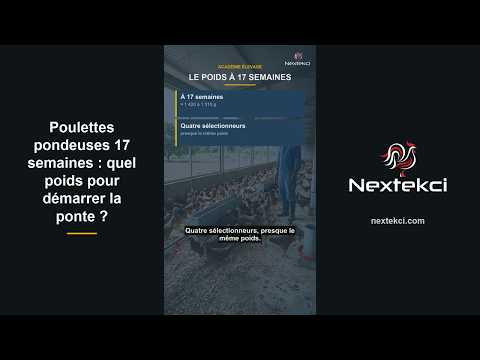 The pullet, the weight that decidesNEXTEKCI · Lesson 2726
 Making it to the first eggNEXTEKCI · Lesson 2827
 Making it to the first eggNEXTEKCI · Lesson 2828
 Reading your laying curveNEXTEKCI · Lesson 2929
 Egg production drops, the investigation in orderNEXTEKCI · Lesson 3030
 Lighting during layNEXTEKCI · Lesson 3131
 The shell: reading the egg to make correctionsNEXTEKCI · Lesson 3232
 Nests and egg collectionNEXTEKCI · Lesson 3333
 Culling, when the flock no longer paysNEXTEKCI · Lesson 35