
What would you like to watch? Tap a category.
The NEXTEKCI Academy
The founder’s lessons, in the order of the programme. Start with the first one: at the end of each video, the next one starts by itself.
The feeder, where the feed goes
 Presented by Abdul Hussein ChoumanFounder of NEXTEKCI · Agnibilékrou hatchery since 2006

Lesson text
End of flock. You remove the old litter. Under each feeder, it is full of feed.
You have paid for or produced this feed. No chicken has turned it into meat.
The feeder is not just a simple container. This is where your feed is gained or lost.
Four adjustments decide what falls and what is lacking. The first is the filling.
A plate filled to the brim overflows with every peck. What spills over ends up in the litter.
FAO advises never to fill it more than one third. It is better to fill often than to overfill.
The second is the height. The edge of the plate is adjusted to the level of the chicken's back.
It grows quickly, so the height is checked every day. If plates are overturned, they are too high.
The third is the places. One plate serves forty-five to eighty chickens, and the lower end of the range for those we sell heavy.
For one thousand chickens, plan for thirteen to twenty-three plates. The heavier they go, the more you need.
When places are lacking, the strongest eat first. The others wait their turn or go foraging on the ground.
The fourth is the strictest. The feeder is never left empty. Feed interruption is prohibited throughout the rearing.
A batch that is hungry starts scratching, then swallowing its litter. The litter carries the droppings, and with them the coccidia.
This is the main route by which they enter. An empty feeder opens the door for them.
So how much are you really losing? I suggest two simple measurements for you to do yourself.
One morning, spread an open empty sack under a feeder. In the evening, collect and weigh what has fallen on it.
Multiply by your feeders, then by the days of the flock. Your waste appears in kilos, black on white.
The second measurement is done at the end of the flock. Count the sacks poured and the kilos of chicken sold.
If the sacks increase from one flock to another for the same weight, first check under your feeders.
And at your place, at the end of the flock, is the litter under the feeders full of feed?
Do the empty sack test, and send us the weight on WhatsApp, at 05 44 83 27 79. And we will offer you our flock record book.
Your orders for chicks go through 07 07 72 78 67. Subscribe, and we will then read the morning droppings.
Your chicks are born before our eyes, in Agnibilékrou. With Nextekci, every customer is a satisfied farmer.
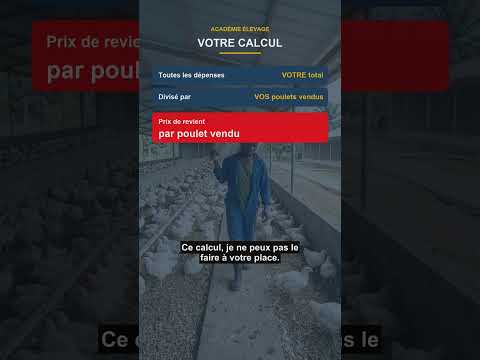 The cost price of a chickenNEXTEKCI · Lesson 102
 The extra kilo of feedNEXTEKCI · Lesson 113
 Weighing to ManageNEXTEKCI · Lesson 124
 The last days before saleNEXTEKCI · Lesson 135
 The worst place to saveNEXTEKCI · Lesson 146
 Homemade feedNEXTEKCI · Lesson 157
 The feed storeNEXTEKCI · Lesson 168
 The feed storeNEXTEKCI · Lesson 169
 Changing feedNEXTEKCI · Lesson 1710
 Changing feedNEXTEKCI · Lesson 17▶
 The feeder, where the feed goesNEXTEKCI · Lesson 1812
 The Morning DroppingsNEXTEKCI · Lesson 1913
 When deaths increaseNEXTEKCI · Lesson 2014
 When deaths increaseNEXTEKCI · Lesson 2015
 Heat, in the right orderNEXTEKCI · Lesson 2116
 Heat, in the right orderNEXTEKCI · Lesson 2117
 Litter, the chain that starts from a leakNEXTEKCI · Lesson 2218
 Litter, the chain that starts with a leakNEXTEKCI · Lesson 2219
 Close the night without suffocating the flockNEXTEKCI · Lesson 2320
 Closing up at night without suffocating the flockNEXTEKCI · Lesson 2321
 The water line, from the insideNEXTEKCI · Lesson 2422
 The farm entranceNEXTEKCI · Lesson 2523
 The sanitary break, step by stepNEXTEKCI · Lesson 2624
 The pullet, the weight that decidesNEXTEKCI · Lesson 2725
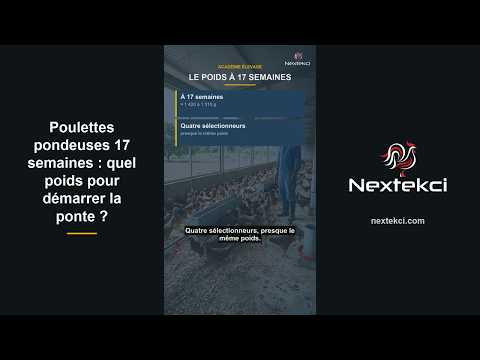 The pullet, the weight that decidesNEXTEKCI · Lesson 2726
 Making it to the first eggNEXTEKCI · Lesson 2827
 Making it to the first eggNEXTEKCI · Lesson 2828
 Reading your laying curveNEXTEKCI · Lesson 2929
 Egg production drops, the investigation in orderNEXTEKCI · Lesson 3030
 Lighting during layNEXTEKCI · Lesson 3131
 The shell: reading the egg to make correctionsNEXTEKCI · Lesson 3232
 Nests and egg collectionNEXTEKCI · Lesson 3333
 Culling, when the flock no longer paysNEXTEKCI · Lesson 35