
Auditing a farm: the expert's grid (house, bird, feed, water, health, data, staff)
When you walk into a farm, you first see what jumps out: a torn curtain, an empty feeder, a worker sitting down. And you leave with three remarks about what you saw, having missed the four problems that mattered. An audit is the opposite of an impression: a fixed grid, the same seven domains in the same order for every farm, a score per point, and a total you can compare from one visit to the next. This lesson gives you the expert's complete grid, the way to score, and a filled-in example on a real farm in the Agnibilékrou area, so that your next visit leaves a record and not a memory.
14 min read · 20-question assignment at the end (16 to pass)
 By Abdul Hussein ChoumanFounder of NEXTEKCI · Agnibilékrou hatchery since 2006
This lesson is part of Level 15 — Expert adviser: project, audit and passing it on. It opens to registered students who have passed the level 14 exam. Levels 1 to 5 remain readable by everyone.
When you walk into a farm, you first see what jumps out: a torn curtain, an empty feeder, a worker sitting down. And you leave with three remarks about what you saw, having missed the four problems that mattered. An audit is the opposite of an impression: a fixed grid, the same seven domains in the same order for every farm, a score per point, and a total you can compare from one visit to the next. This lesson gives you the expert's complete grid, the way to score, and a filled-in example on a real farm in the Agnibilékrou area, so that your next visit leaves a record and not a memory.
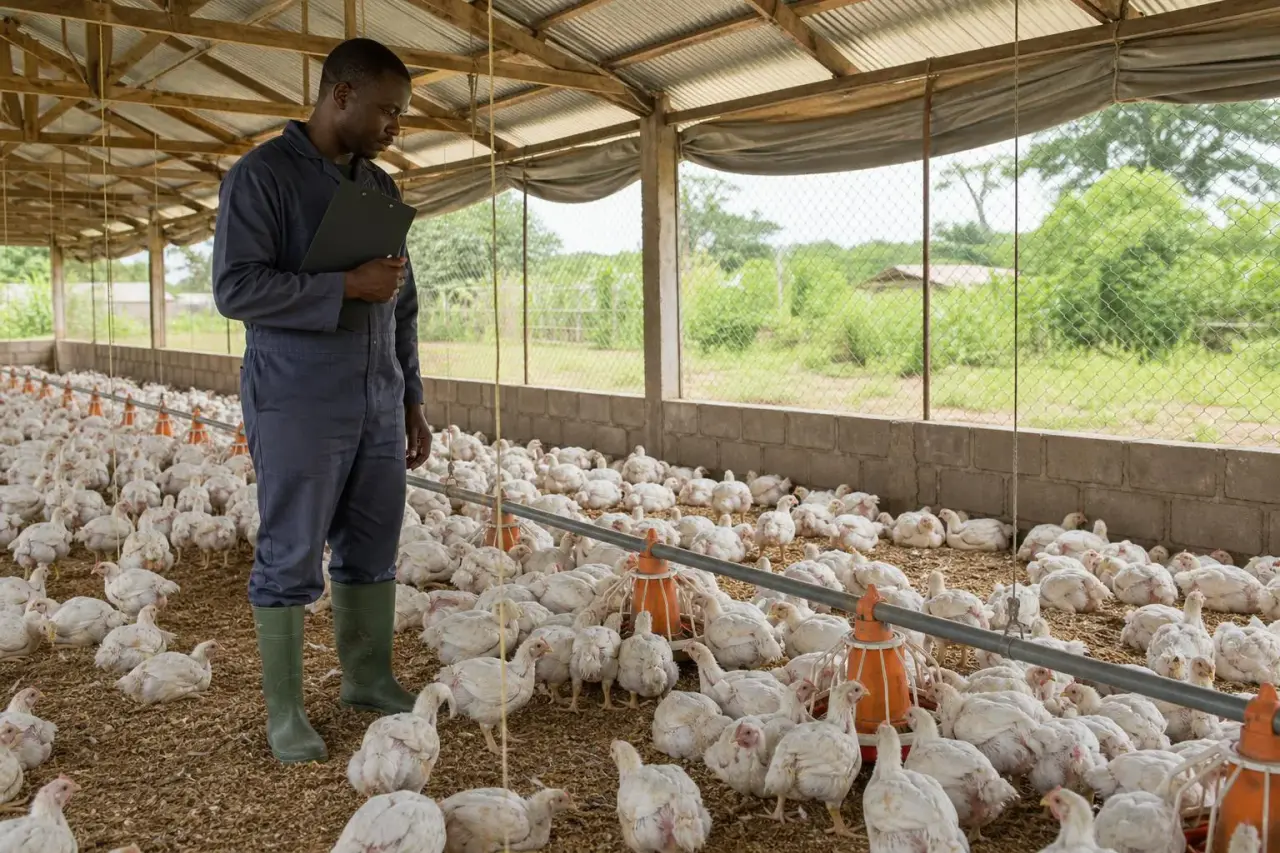
- ✓Define what an audit is and what sets it apart from a visit or an inspection
- ✓Use the grid in seven domains (house, bird, feed, water, health, data, staff) with its 0-1-2 scoring
- ✓Observe and measure each point with the right gesture, without relying on statements
- ✓Calculate the score per domain and the overall score, and read what they say about the farm
- What an audit is, and why a grid
- The 0-1-2 scoring and the auditor’s rules
- The complete grid: the seven domains and their points
- Filled-in example: a broiler farm 20 km from Agnibilékrou, one day in March
- Reading the scores: the expert’s thresholds
- Going further
- •Audit = methodical examination according to a written grid, which measures the state of the farm on a date; it is neither a visit nor an inspection, and the advice comes afterwards.
- •Grid in 7 domains (house, bird, feed, water, health, data, staff), 5 points each, scored 0-1-2, NA not counted; domain score = points ÷ (2 × applicable points); overall = average of the 7.
- •Rules: we measure, we do not believe; we go everywhere; we score on the spot; we correct nothing during; we come at 2 pm in the hot season.
- •Example: 1,600 chickens on 240 m² in March (6.7 per m², NEXTEKCI advises 5), water at 35 °C, +3 °C in the house, weight −10%: overall 57%, water 30%; the profile guides the advice, not the total.
- •Thresholds: domain < 40% = danger, priority 1; 40-60% fragile; > 80% to be shown as an example; a 0 on a vital point (water > 32 °C, density > 7 in heat) comes before everything.
© NEXTEKCI, Agnibilékrou · Lessons protected by copyright · Terms of use · Privacy policy