
Dead birds and waste: incineration, burial, hygiene rules
Even on the best farm, chickens die: 3 to 5% of a flock is normal. What is not normal is the carcass thrown behind the house, eaten by the neighbour's dog, or left on the bank of the stream. Every dead bird is a bag of microbes waiting for a rat, a fly or a boot to come back into your house. This lesson teaches you to calculate what your farm must dispose of, to build a pit or an incinerator that does not pollute, to keep the register the veterinary service asks for, and to manage the other waste: bags, bottles, needles, plastics.
13 min read · 20-question assignment at the end (16 to pass)
 By Abdul Hussein ChoumanFounder of NEXTEKCI · Agnibilékrou hatchery since 2006
This lesson is part of Level 14 — Environment, regulation and sustainability. It opens to registered students who have passed the level 13 exam. Levels 1 to 5 remain readable by everyone.
Even on the best farm, chickens die: 3 to 5% of a flock is normal. What is not normal is the carcass thrown behind the house, eaten by the neighbour's dog, or left on the bank of the stream. Every dead bird is a bag of microbes waiting for a rat, a fly or a boot to come back into your house. This lesson teaches you to calculate what your farm must dispose of, to build a pit or an incinerator that does not pollute, to keep the register the veterinary service asks for, and to manage the other waste: bags, bottles, needles, plastics.
- ✓Estimate the mass of dead birds to dispose of per flock, with a worked calculation
- ✓Build and run a burial pit and a simple incinerator, at a safe distance from water
- ✓Apply hygiene rules from collection to disposal and keep the mortality register
- ✓Sort and dispose of the farm's other waste: packaging, bottles, needles, plastics
- Why a carcass is a danger, and how many there are
- Collection: the hygiene rules
- The burial pit: building and running it
- Incineration and carcass composting
- The other waste: sorting is protecting
- The register: what you note and why
- Going further
- •3 to 5% losses per flock are normal: 240 birds and about 150 kg for 6,000 broilers, of which 108 kg in the last two weeks; possible peak of 100 kg in one hot day.
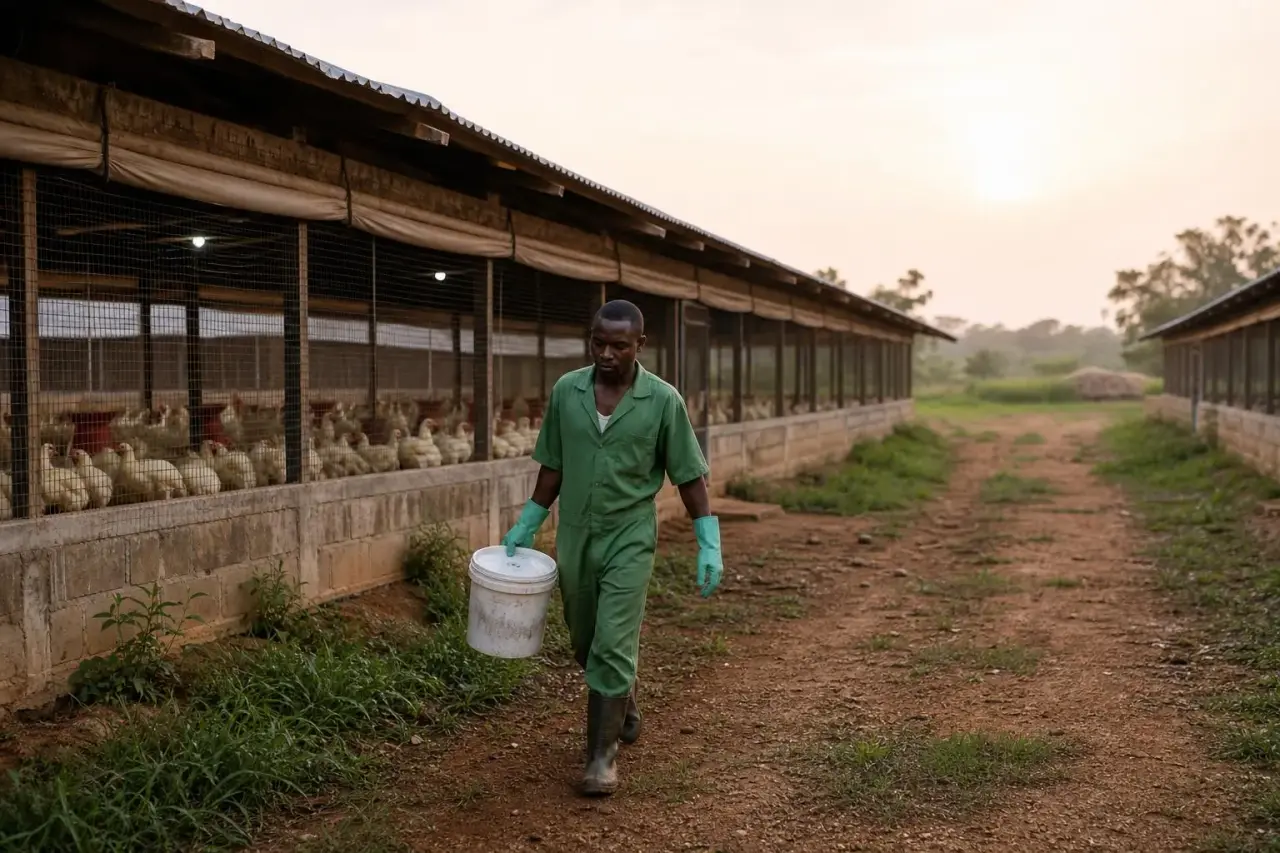
- •Collection twice a day, gloves, closed reserved bucket, counting and observation, dirty path, never a carcass overnight in the house, never given away or sold.
- •Pit: 50 m from water, bottom 1 to 1.5 m above the water table (test hole in the rainy season), out of lowlands, 2 × 2 × 2.5 m lined, slab and lid, lime at each deposit.
- •Drum incinerator on a grate with a chimney (20 to 30 kg in 2 to 3 h), or carcass composting bin at 55-65 °C; never an open fire.
- •Waste sorted into three closed bins (hazardous, plastics, compost); daily mortality register with the zeros, cumulative percentage every week, alert above 1% per day.
© NEXTEKCI, Agnibilékrou · Lessons protected by copyright · Terms of use · Privacy policy