
Neighbours and the site: distances, nuisances, good relations
A farm does not live alone: it has neighbours who smell its odours, count its flies, hear its generator and drink the water that passes beneath it. Many well-run farms have closed not because of disease, but because of a land dispute or a complaint in the village. This lesson teaches you to choose and read a site, to respect reasonable distances, to measure and reduce each nuisance, and to build with the village and the administration the relations that protect the farm on the day something goes wrong.
12 min read · 20-question assignment at the end (16 to pass)
 By Abdul Hussein ChoumanFounder of NEXTEKCI · Agnibilékrou hatchery since 2006
This lesson is part of Level 14 — Environment, regulation and sustainability. It opens to registered students who have passed the level 13 exam. Levels 1 to 5 remain readable by everyone.
A farm does not live alone: it has neighbours who smell its odours, count its flies, hear its generator and drink the water that passes beneath it. Many well-run farms have closed not because of disease, but because of a land dispute or a complaint in the village. This lesson teaches you to choose and read a site, to respect reasonable distances, to measure and reduce each nuisance, and to build with the village and the administration the relations that protect the farm on the day something goes wrong.
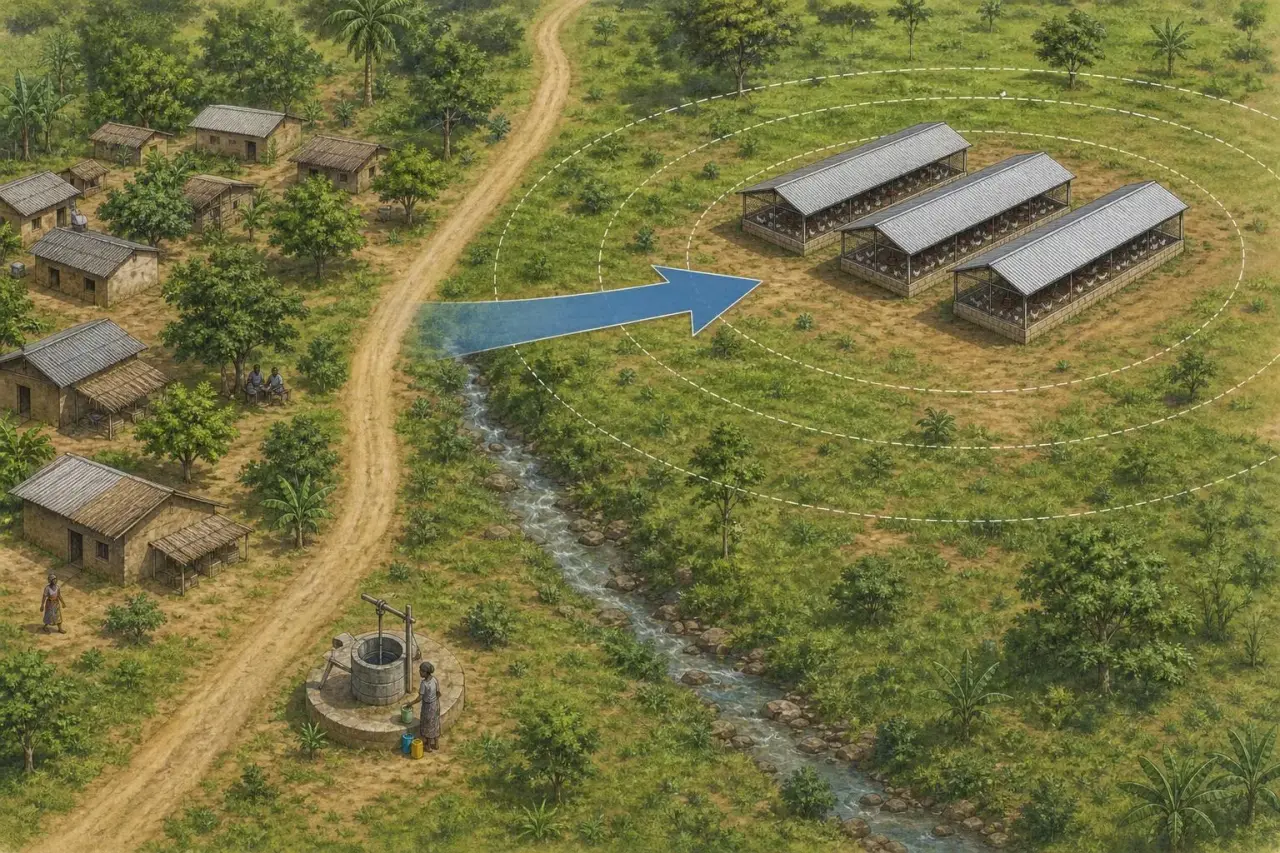
- ✓Read a site: slope, wind, water, access, neighbours, and deduce where to place each element of the farm
- ✓Apply reasonable distances between the houses, dwellings, water points and other poultry farms
- ✓Identify the five nuisances of a farm, measure them and reduce them at source
- ✓Build good relations with the village, the neighbours and the administration, and maintain them
- Reading the site before building or expanding
- Reasonable distances
- The five nuisances, and how to reduce them
- Good relations: before, during, after
- The farm's neighbourhood sheet
- Going further
- •Read the site: prevailing wind (houses across it, nuisances downwind), slope and water (houses on top, pit downhill, never in a lowland), neighbours and water points within 1 km, access in the rainy season, land question settled before building.
- •Distance benchmarks: 100 m from dwellings (200 m beyond 10,000 birds), 300 m from a school or a market, 50 m between pit or manure and any water point, 30 to 50 m between pit and houses, 500 m to 1 km from another poultry farm, 15 to 20 m between houses; local regulations take precedence.
- •Five nuisances (odours, flies, noise, dust, water and traffic): each is measured every week and reduced at source; two-row windbreak hedge 10 m from the houses.
- •Relations: visit to the chief and the neighbours beforehand, local hiring, warning the day before, compost offered, complaints channel with a visit within 48 h, complaints book, never deny an odour.
- •One-page neighbourhood sheet, filled in every week, read in one minute, proof before the administration.
© NEXTEKCI, Agnibilékrou · Lessons protected by copyright · Terms of use · Privacy policy