
Case study: plan a year of production for three houses
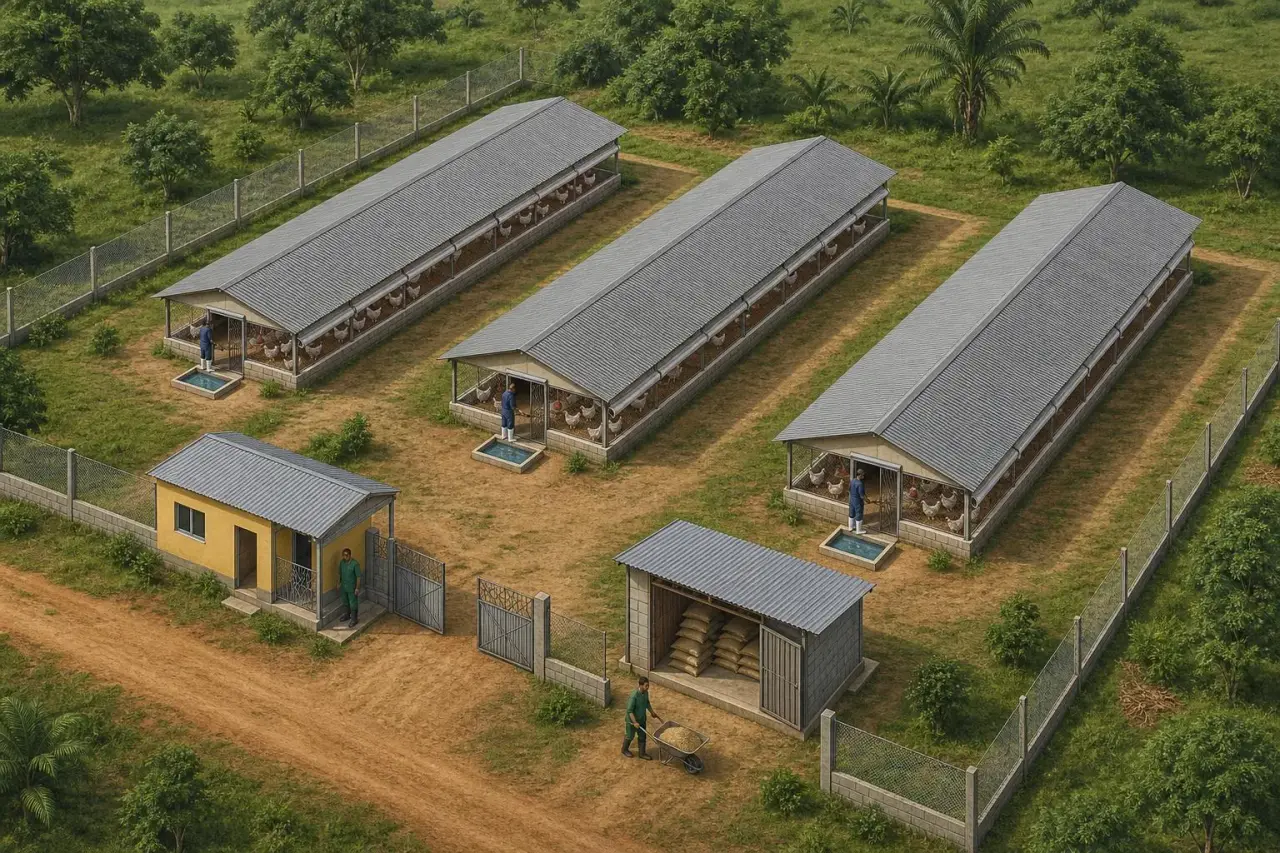
An entrepreneur in the Yamoussoukro area has three open-sided houses of 8 m by 30 m, a manager, a technician, three workers and a guard. In December, he asks his manager: "Give me the planning for the whole of next year: when each house receives, when it sells, how many chicks I order and when, and I want two houses ready for the end-of-year festivals." This lesson does the manager's work from start to finish, with the reasoning, the calculations and the complete calendar as a table, then shows the hard points of the year and what you watch so that the plan holds. It is the typical exercise of this level.
15 min read · 20-question assignment at the end (16 to pass)
 By Abdul Hussein ChoumanFounder of NEXTEKCI · Agnibilékrou hatchery since 2006
This lesson is part of Level 13 — Organising the farm: staff, procedures, planning. It opens to registered students who have passed the level 12 exam. Levels 1 to 5 remain readable by everyone.
An entrepreneur in the Yamoussoukro area has three open-sided houses of 8 m by 30 m, a manager, a technician, three workers and a guard. In December, he asks his manager: "Give me the planning for the whole of next year: when each house receives, when it sells, how many chicks I order and when, and I want two houses ready for the end-of-year festivals." This lesson does the manager's work from start to finish, with the reasoning, the calculations and the complete calendar as a table, then shows the hard points of the year and what you watch so that the plan holds. It is the typical exercise of this level.
- ✓Set out the starting data of an annual planning: cycle, stagger between houses, seasons and the density advised by NEXTEKCI, festivals, team, transport
- ✓Build the complete calendar of a year for three houses in staggered flocks, with bird numbers, sale dates and downtimes
- ✓Derive from it the chick order dates, the feed and work peaks, and the cash plan
- ✓Say what you check during the year so that the planning stays true, and how you correct it
- The starting data and the manager's five rules
- The reasoning, step by step
- The calendar of the year, house by house
- Chick orders and transport
- The hard points of the year: feed, work, cash
- Keeping the plan alive: what you check, how you correct
- Going further
- •Starting data: three houses of 240 m², cycle 42 + 14 = 56 days, stagger of 19 days, 1,200 chicks in hot weather (5 per m², NEXTEKCI's advice; manufacturers 8 to 10) and 2,000 the rest of the year, collection on arrival of route 2 at Yamoussoukro, calendar backwards from the festivals.
- •Reasoning in five steps: regular skeleton, season, position of the end-of-year sales, extended downtimes to line up two houses with the festivals (H1: 40 days; H3: annual major downtime of 31 days), load check.
- •Result: 18 arrivals, 17 sales in the year, 32,000 chicks, about 30,400 chickens, 3,100 bags, 360 m³ of litter; festival sales on 13 and 20 December; H3 sold on 18 January.
- •Eighteen orders at D−35 (six weeks for the festival ones), carrier at D−21, preheating at D−2; the first two orders of the year are placed in December of the previous year.
- •Hard points written with their measures: heat (January-April), rains (May-July), cash and two close broodings (October-November), the fortnight of 7 to 22 December (day labourer, gas, days off postponed, buyers confirmed); reread every Monday, actual dates in pencil, the 14-day downtime is not negotiable.
© NEXTEKCI, Agnibilékrou · Lessons protected by copyright · Terms of use · Privacy policy