
Fighting heat: roofing, misting, fans, feeding hours
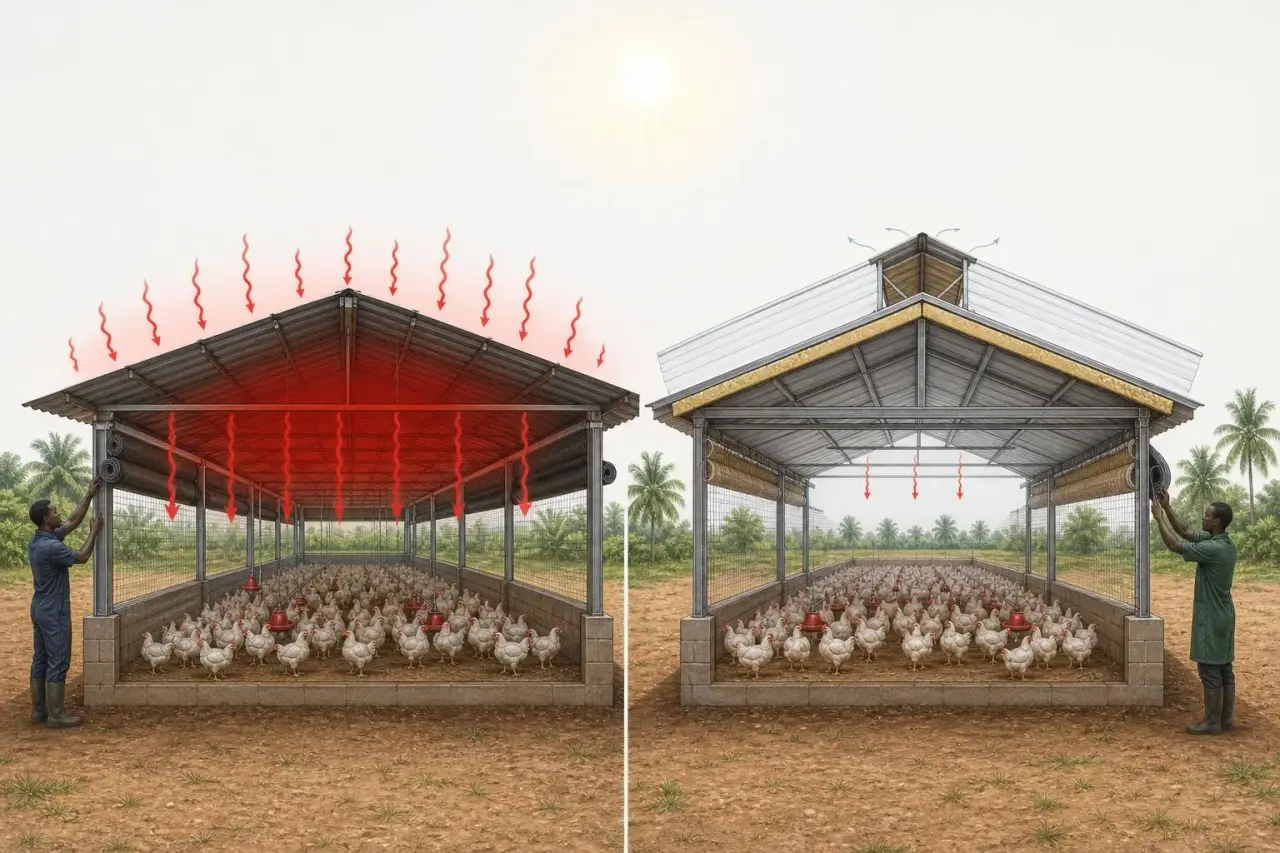
Between March and May, and on every windless afternoon, the house thermometer passes 33 °C and chickens over four weeks old open their beaks. You cannot air-condition an open-sided house, but you can act on five levers: stop heat getting in (roofing), get it out (moving air), cool the air when it is dry (misting), shift meals to the cool hours and keep the water cold. This lesson gives the action plan, hour by hour, for a 34 °C day.
12 min read · 20-question assignment at the end (16 to pass)
 By Abdul Hussein ChoumanFounder of NEXTEKCI · Agnibilékrou hatchery since 2006
This lesson is part of Level 8 — Climate control and housing in a hot climate. It opens to registered students who have passed the level 7 exam. Levels 1 to 5 remain readable by everyone.
Between March and May, and on every windless afternoon, the house thermometer passes 33 °C and chickens over four weeks old open their beaks. You cannot air-condition an open-sided house, but you can act on five levers: stop heat getting in (roofing), get it out (moving air), cool the air when it is dry (misting), shift meals to the cool hours and keep the water cold. This lesson gives the action plan, hour by hour, for a 34 °C day.
- ✓Explain how heat gets into the house and how the chicken gets rid of it
- ✓Choose and install a roof and shade that reduce the heat received
- ✓Size and place circulation fans and misting, and know when not to mist
- ✓Apply the hot-day plan: feeding hours, cool water, the technician’s actions
- Where heat comes from, and how the chicken gets rid of it
- Roofing and shade: stopping heat getting in
- Circulation fans: getting heat out
- Misting: useful when the air is dry, harmful when it is humid
- Feeding hours and cool water
- Going further
- •Three heat sources: the roof (sheet at 60-70 °C), the birds (12 W per 2 kg chicken), the outside air; act on the first two.
- •Roofing: white paint, insulating under-roof, open ridge, roof overhang, shade from tall-trunked trees.
- •Fans of 90 cm minimum, 1 m from the floor, in the direction of the wind, one per 10 to 12 m; from 28 °C after 28 days; target 1.75 to 2.5 m/s on the ribbon.
- •Misting from 28 °C, never above 70% humidity, in cycles, always with the fans.
- •Feeders raised 6 h before the peak, meals in the cool hours with light, water under 25 °C, flushes every 2 h, get the birds up; density 5 per m² in heat.
© NEXTEKCI, Agnibilékrou · Lessons protected by copyright · Terms of use · Privacy policy