A farm's organisation chart: who does what, from the guard to the manager
As long as a farm fits in a single house, one person can carry everything in their head. As soon as there are three houses, with six people crossing paths from morning to night, the head is no longer enough: one task is done twice, another is done by nobody, and the day the worker of house 2 is ill, nobody knows who replaces him. This lesson teaches you to draw the organisation chart of a farm, to write the job description of everyone, from the guard to the manager, and to enforce a simple rule: everyone knows who gives them orders and who they report to.
13 min read · 20-question assignment at the end (16 to pass)
 By Abdul Hussein ChoumanFounder of NEXTEKCI · Agnibilékrou hatchery since 2006
This lesson is part of Level 13 — Organising the farm: staff, procedures, planning. It opens to registered students who have passed the level 12 exam. Levels 1 to 5 remain readable by everyone.
As long as a farm fits in a single house, one person can carry everything in their head. As soon as there are three houses, with six people crossing paths from morning to night, the head is no longer enough: one task is done twice, another is done by nobody, and the day the worker of house 2 is ill, nobody knows who replaces him. This lesson teaches you to draw the organisation chart of a farm, to write the job description of everyone, from the guard to the manager, and to enforce a simple rule: everyone knows who gives them orders and who they report to.
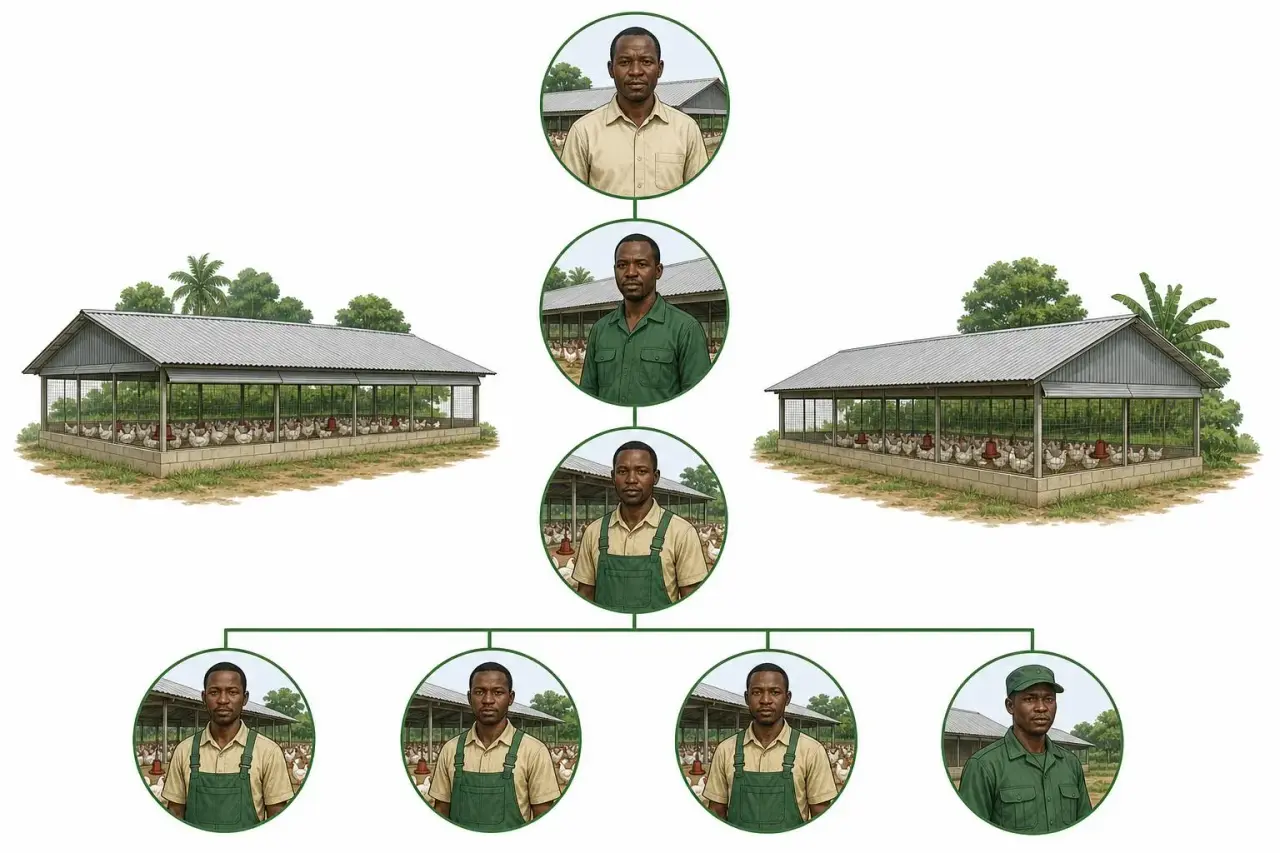
- ✓Draw the organisation chart of a farm with several houses and place each person in a box
- ✓Write a complete job description (missions, tasks, expected results, replacement) for each role
- ✓Apply the rule of unity of command and set what each person may decide alone
- ✓Adapt the organisation chart to the real size of the farm, from one person to ten
- What an organisation chart is, and why a farm needs one
- The five functions of a farm, and the example's organisation chart
- Staffing benchmarks: how many people for how many chickens
- The job description: the clear contract of each box
- Two rules that hold the organisation chart together
- Adapting the organisation chart to the real size of the farm
- Going further
- •The organisation chart shows who does what and who depends on whom; the five functions (direct, run the flock, execute, guard, supply and sell) exist on every farm, even one run by a single person.
- •Benchmarks: 1 worker for 2,000 to 3,000 broilers, 1 technician for 3 to 6 houses, a manager as soon as the entrepreneur is not on site, a guard per site, a replacement per position.
- •The job description fits on one page: title, single superior, mission, tasks with times, forbidden actions, figures as results, replacement, signatures; it is posted and reread at each flock.
- •Unity of command: one single superior per person, except in an emergency; written delegation: what the manager decides alone and what goes up to the entrepreneur.
- •On the example farm (3 houses of 8 × 30 m, 2,000 broilers each in the cool season, 1,200 in hot weather as NEXTEKCI advises), the team is: manager, technician, three workers, guard.
© NEXTEKCI, Agnibilékrou · Lessons protected by copyright · Terms of use · Privacy policy