
Water, the first feed: quantity, temperature, quality, and its effect on intake
The chicken drinks almost twice what it eats, and much more when it is hot. Its body is 70% water. When water is lacking, too warm or bad, the first thing to fall is feed intake, then weight, then health. In a level devoted to nutrition, water is not a detail: it is the nutrient you measure first every morning, because it announces all the others.
12 min read · 20-question assignment at the end (16 to pass)
 By Abdul Hussein ChoumanFounder of NEXTEKCI · Agnibilékrou hatchery since 2006
This lesson is part of Level 7 — Feed and nutrition. It opens to registered students who have passed the level 6 exam. Levels 1 to 5 remain readable by everyone.
The chicken drinks almost twice what it eats, and much more when it is hot. Its body is 70% water. When water is lacking, too warm or bad, the first thing to fall is feed intake, then weight, then health. In a level devoted to nutrition, water is not a detail: it is the nutrient you measure first every morning, because it announces all the others.
- ✓Forecast a flock's water quantity by age and temperature, and compare it with the meter reading
- ✓Explain the effect of water temperature on feed intake and act on it
- ✓Judge water quality with simple criteria and know when to have it analysed
- ✓Use the water-to-feed ratio as a daily warning signal
- Water is a nutrient: how much, and why
- Water temperature: the detail that changes everything in Côte d'Ivoire
- Water quality: what you check, and when you analyse
- Water as a signal: the water-to-feed ratio every day
- Drinking points: enough, well placed, at the right height
- Going further
- •1.6 to 2 litres of water per kilo of feed at 20-26 °C, 3 to 3.5 at 32 °C, 5 at 37 °C; 48-hour reserve at the flow of the hottest day.
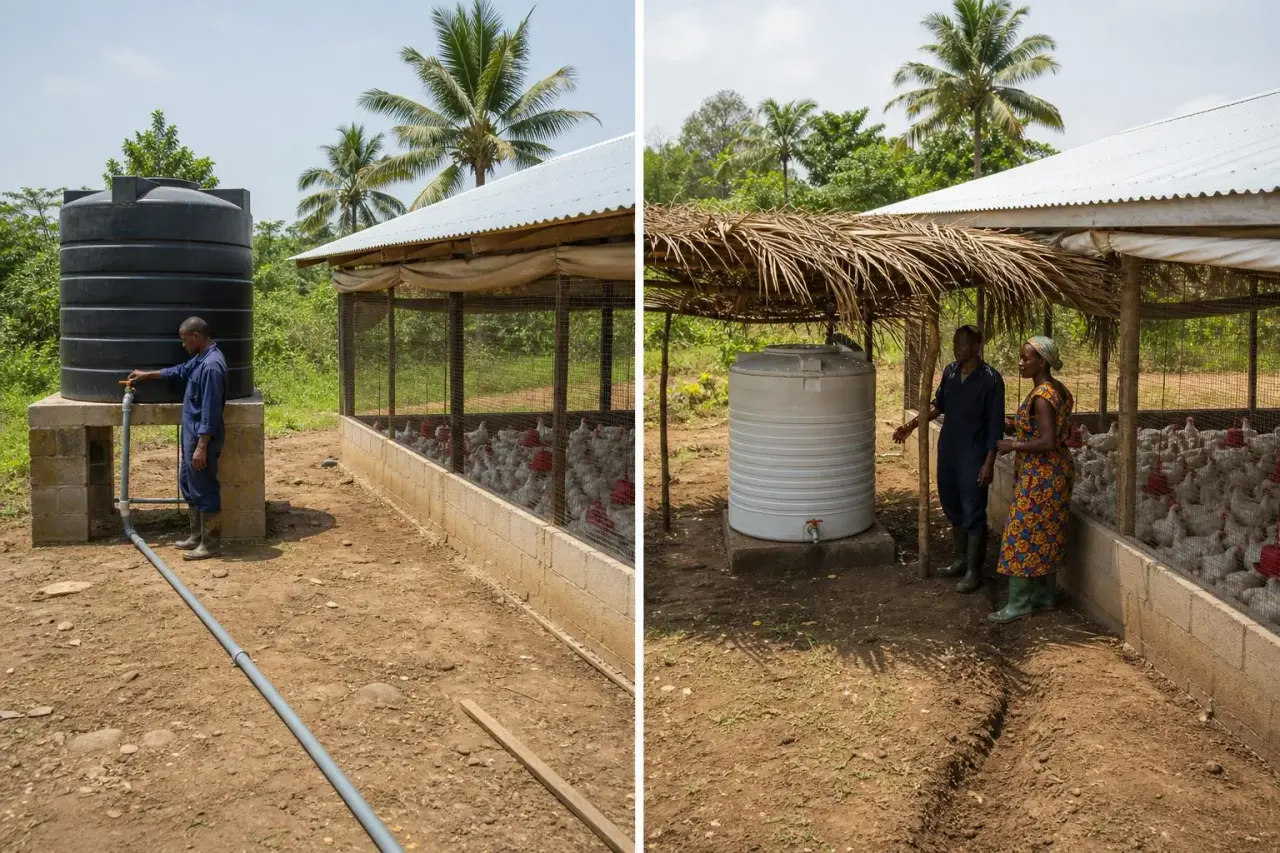
- •Cool water wanted between 15 and 25 °C; above 30 °C the chicken drinks less and eats less: tank in the shade, protected pipes, flushes at noon and 3 pm, filling at night.
- •Quality: clear, odourless, pH 6 to 7.5, no bacteria or nitrates or excess salt; annual analysis at the end of the rainy season; disinfection settled with the technician or the veterinarian according to the pH.
- •The water-to-feed ratio moves 24 to 48 hours before any other sign: a 10% drop at equal heat = walk the lines within the hour.
- •10 to 12 birds per nipple, 1 bell of 40 cm for 80 to 100, never more than 3 m to walk to drink, nipples at the back tested every morning.
© NEXTEKCI, Agnibilékrou · Lessons protected by copyright · Terms of use · Privacy policy