
Technical guide · NEXTEKCI School
Poultry farm management and profitability guide
Count your costs, calculate your margin, plan your flocks and run your farm with your own figures
Method: NEXTEKCI School management lessons (levels 2, 4 and 5) · no prices imposed: you calculate with your own
Download the guide (PDF)
1. The costs of a flock
A farm makes money when it knows what it spends, line by line. Many farmers count only the chicks and the feed: they think they are making a profit, then find they cannot repair the roof or pay for the next flock. This guide gives no prices: prices change with the season, the region and the supplier. It gives the method so that you can do the calculation with your own.
Cost items
| Item | What it includes | How to measure it |
|---|---|---|
| Chicks | Number of chicks ordered, transport to the farm | Hatchery and haulier invoices |
| Feed | Starter, grower, finisher (or pullet then layer feed) | Bags taken out of the store, per phase, multiplied by the price of a bag |
| Energy | Gas or charcoal for brooding, electricity, generator fuel | Invoices, cylinders and bags used during the flock |
| Water | Borehole, pump, water bill, water haulage | Bill or estimate per flock |
| Labour | Wages and bonuses during the flock, night cover, your own time | Payslips or payment book |
| Health | Vaccines, vet visits, prescribed products, disinfectants | Invoices and prescriptions |
| Litter | Wood shavings, rice husks or other material, top-ups | Purchases for the flock |
| Transport at sale | Crates, vehicle, loading | Haulier invoice |
| Sundries | Bulbs, batteries, bags, phone, routine repairs | Cash book |
| Depreciation | Wear of the house and equipment | Cost spread over the useful life, then over the flocks (see below) |
| Rent and interest | Rent of the land or house, interest on a loan | Contract, repayment schedule |
Benchmarks: NEXTEKCI School lessons, levels 2, 4 and 5
Variable costs and fixed costs
| Type | Definition | Examples |
|---|---|---|
| Variable costs | They rise with the number of birds | Chicks, feed, health, litter, transport at sale |
| Fixed costs | They are there even when the house is empty | Depreciation, rent, interest, the guard’s wage |
Calculating depreciation per flock
- 1Write down what each item cost: the house, then the equipment (feeders, drinkers, brooders, water tank, scales).
- 2Estimate its useful life: for example 10 years for a well-built house, 3 years for feeders and drinkers.
- 3Divide the cost by the useful life: this gives the share for each year.
- 4Divide this yearly share by the number of flocks in the year (5 to 6 flocks of white broilers per house, for example).
- 5Add up the shares: this is the “depreciation” line of each flock.
Benchmarks: NEXTEKCI School lessons, levels 2, 4 and 5
Feed usually accounts for 60 to 70% of the cost of a broiler flock. It is the line where a one per cent improvement pays most: hunt down waste before looking for a discount.
2. Income
The main income looks simple: the birds sold. But what you actually receive depends on the number of birds really sold (after mortality), their weight, the way they are sold and the timing. Several small sources of income are added on top, and are often forgotten.
Where the money comes from
| Income | What makes it vary | To note on the sales sheet |
|---|---|---|
| Broilers sold by the kilo | Average weight, flock uniformity, agreed price per kilo | Number, total weight weighed in front of the buyer, price, buyer |
| Broilers sold per bird | Number sold, categories (large, medium, small) | Number per category, price per category |
| Eggs (layers) | Laying rate, egg size, broken or dirty eggs, regular deliveries | Trays sold by size, downgraded eggs separately |
| Spent hens | Number of hens at the end of lay, condition, weight | Number, price, buyer |
| Manure and used litter | Quantity, demand from market gardeners and planters | Bags or loads sold |
| Empty bags and last birds | Clean feed bags, last birds sold separately | Quantities and amounts received |
Benchmarks: NEXTEKCI School lessons, levels 2, 4 and 5
What lowers income without anyone noticing
- Mortality: a bird that dies at the end of the flock has eaten almost all its feed and brings in nothing.
- Missing birds: theft, predators, birds eaten or given away without being recorded.
- An uneven flock: when selling per bird, the small ones fetch less and pull down the price of the whole flock.
- Selling late: every day without a buyer costs feed and worsens the feed conversion ratio.
- Unpaid credit: a sale that has not been paid for is not income.
Income counts when the money is in the cash box, not when the buyer has promised. Keep a separate note of what is still owed, with the name and date: this is your list of debtors.
3. Calculating your margin
The margin is what is left once all costs have been taken away from income. It is calculated at two levels. The gross margin tells you whether the flock was well managed; the net margin tells you whether the farm is a viable business, able to replace its house and pay its owner.
The formulas
| Calculation | Formula |
|---|---|
| Total income | Bird sales + eggs + spent hens + manure + empty bags |
| Variable costs | Chicks + feed + energy + water + health + litter + labour for the flock + transport |
| Gross margin | Total income − variable costs |
| Fixed costs of the flock | Depreciation + rent + interest, brought down to one flock |
| Net margin | Gross margin − fixed costs of the flock |
| Margin per bird sold | Net margin ÷ number of birds sold |
| Margin per m² | Net margin ÷ usable floor area of the house |
Benchmarks: NEXTEKCI School lessons, levels 2, 4 and 5
Worked example, with letters instead of prices
- 1The flock: 1,000 chicks received, 960 broilers sold at an average of 2.0 kg, so 1,920 kg sold. Feed taken out of the store: 64 bags of 50 kg, so 3,200 kg.
- 2Replace each price with a letter: P = price of one chick, A = price of one bag of feed, V = selling price of one kilo, D = all the other costs of the flock (energy, water, health, litter, labour, transport, depreciation).
- 3Total costs: T = 1,000 × P + 64 × A + D.
- 4Income: R = 1,920 × V (add manure and empty bags if you sell them).
- 5Net margin: R − T. Cost per kilo: T ÷ 1,920. If V is smaller than T ÷ 1,920, every kilo you sell loses you money.
- 6Now replace the letters with your own prices: the calculator does this calculation for you.
Example taken from the lesson “The feed conversion ratio” (level 4)
Three scenarios before every flock
- If all goes well: your best figures (mortality, weight, feed conversion ratio).
- If things go moderately: 10% more losses and sales one week late.
- If things go badly: heat, disease, low selling prices.
- Rule: if the middle scenario already gives a negative margin, do not start the flock as it is. Change something first (number, type of chick, buyer, date).
Benchmarks: NEXTEKCI School lessons, levels 2, 4 and 5
Do the account of each flock in the week after the sale, while the invoices and weighings are still to hand. One flock on its own says little; three flocks side by side show at once where the difference is made.
4. Cost per kilo and cost per egg
The production cost is the figure that lets you answer a buyer in a second: “below this price, I lose money”. It is your negotiating threshold. It is calculated after each flock, with the real figures, and compared with the average selling price.
Production cost formulas
| Production | Production cost | Compare with |
|---|---|---|
| Broilers sold by the kilo | Total costs of the flock ÷ kilos sold | Income ÷ kilos sold (average price obtained per kilo) |
| Broilers sold per bird | Total costs of the flock ÷ number of broilers sold | Income ÷ number of broilers sold |
| Eggs | Costs for the period ÷ saleable eggs | Egg income ÷ eggs sold |
| Tray of 30 eggs | Cost per egg × 30 (+ the empty tray) | Average price obtained per tray |
Benchmarks: NEXTEKCI School lessons, levels 2, 4 and 5
Cost per egg: the special points
- A pullet costs money before she lays: the chick and all the feed from day old to the start of lay (around 21 weeks) are spread over the whole laying period.
- Spent hens bring in money at the end of lay: their income is deducted from the total cost of the flock.
- Only saleable eggs count: broken, cracked or dirty eggs are removed before dividing.
- The laying rate is everything: the higher it is, the more eggs the day’s costs are shared across.
What moves the cost per kilo
| Lever | Effect |
|---|---|
| Feed conversion ratio | One tenth of a point on 1,920 kg sold = 192 kg of feed, nearly 4 bags of 50 kg |
| Mortality | Every dead bird has cost its chick and its feed without being sold |
| Selling weight | More kilos sold for the same fixed costs, as long as the feed conversion ratio stays good |
| Selling age | Beyond 6 weeks for white broilers, each extra kilo costs more and more feed |
| Stocking density | Too many birds: heat, mortality, uneven flock; too few: fixed costs badly spread |
Benchmarks: NEXTEKCI School lessons, levels 2, 4 and 5
Break down your cost per kilo: the share of feed, of chicks, of everything else. If the price of feed rises by 10% and feed makes up two thirds of your costs, your cost per kilo rises by about 6 to 7%. Redo the calculation as soon as a price changes.
5. The technical indicators to monitor
The margin shows at the end of the flock. Technical indicators show every day or every week: they are what allow you to correct things in time. Each one is calculated from the daily record sheet and the weighings.
The formulas
| Indicator | Formula | Frequency |
|---|---|---|
| Feed conversion ratio (FCR) | Kilos of feed eaten ÷ kilos of live weight sold | Estimated every week, actual at the end of the flock |
| Cumulative mortality | (Dead + culled) ÷ chicks received × 100 | Every day |
| Liveability | 100 − cumulative mortality | End of flock |
| Average weight | Total weight of a weighed sample ÷ number of birds weighed | Every week |
| Uniformity | Birds weighed within plus or minus 10% of the average weight ÷ birds weighed × 100 | Every week |
| Water / feed ratio | Litres of water drunk ÷ kilos of feed eaten | Every day |
| Laying rate | Eggs collected in the day ÷ hens present × 100 | Every day |
| Eggs per hen | Cumulative eggs ÷ hens housed | Every week |
| Layer FCR | Kilos of feed ÷ kilos of eggs produced | Every month |
| Production efficiency factor (broilers) | Liveability (%) × average weight (kg) ÷ (age at sale in days × FCR) × 100 | End of flock |
Benchmarks: NEXTEKCI School lessons, levels 2, 4 and 5
The School’s benchmarks
| Indicator | Good | To correct |
|---|---|---|
| FCR, white broilers sold at 35 to 42 days, open-sided house | 1.6 to 1.8 | Above 2.0 |
| FCR, coloured broilers | 2.6 to 3.0 | Above 3.5 |
| FCR, layers (kg of feed per kg of eggs) | 2.0 to 2.3 | Above 2.6 |
| Mortality over the whole flock (white broilers) | 3 to 5% | Above 7% |
| Average weight compared with target | Gap below 5% | Gap above 10% |
| Water / feed ratio | 1.6 to 2 | Below 1.5 or above 3 |
| Uniformity | 70% or more | Below 70% |
Benchmarks: NEXTEKCI School lessons, levels 2, 4 and 5
Example of a production efficiency factor: a white broiler flock sold at 42 days, with 95% liveability, an average weight of 2.1 kg and an FCR of 1.75, gives 95 × 2.1 ÷ (42 × 1.75) × 100, about 271. This factor sums up survival, growth and feed efficiency in a single figure. The higher it is, the better. Compare it from one flock to the next, in your own house.
Compare yourself first with your previous flock, not with the strain suppliers’ performance tables obtained in closed, climate-controlled houses. Progress is measured on your own farm, flock after flock: a tenth of a point of FCR, one point of mortality, a few per cent of uniformity.
6. Planning your flocks
A house left empty for no reason earns nothing, but a house that never has a downtime period ends up making the flocks ill. Planning looks for the balance: a house occupied as often as possible, a real downtime between two flocks, and sales that fall at the right moment.
The length of a cycle
| Production | Rearing | Cleaning and downtime | Full cycle |
|---|---|---|---|
| White broilers | About 6 weeks | About 2 weeks | About 8 weeks, so 5 to 6 flocks a year |
| Coloured and hybrid chickens | 10 to 14 weeks depending on the target weight | About 2 weeks | 12 to 16 weeks |
| Layers | Start of lay around 21 weeks, culled around 72 to 74 weeks | About 2 weeks, longer after disease | More than a year per flock |
Benchmarks: NEXTEKCI School lessons, levels 2, 4 and 5
Several houses in rotation
- One age per house (all in, all out): never two ages mixed, not even to “fill a gap”.
- Staggered houses: with three white broiler houses, a flock goes out about every two and a half weeks; with two, about once a month.
- Houses 15 to 20 metres apart, visited from the youngest to the oldest, with boots for each house.
- One record sheet per house and per flock, never a shared sheet.
- Cash must cover the feed of all the flocks in progress until the next sale, not just one.
- Broilers and layers: separate sites, or at least distant houses with strict boots and visiting order.
Benchmarks: NEXTEKCI School lessons, levels 2, 4 and 5
Building the calendar backwards
- 1Choose the selling date: two weeks before a festival rather than two weeks after.
- 2Subtract the rearing period (6 weeks for white broilers, 10 to 14 weeks for coloured chickens): this gives the chicks’ arrival date.
- 3Check that the house will be cleaned, disinfected and ready the day before that date, downtime included.
- 4Subtract a further 15 days, more before festivals: this is the deadline for pre-ordering the chicks.
- 5Write everything on a calendar for the year: festivals, seasons, flocks, downtimes, pre-orders, payment dates.
Benchmarks: NEXTEKCI School lessons, levels 2, 4 and 5
The key moments of the year
| Period | What to plan |
|---|---|
| End of year (Christmas, New Year) | Strong demand: pre-order chicks early, book buyers a month ahead |
| Easter | Rising demand: prepare the flock accordingly |
| End of Ramadan and Tabaski | Dates that move forward by about 11 days each year: check them for every calendar |
| Start of the school year | Family spending: household demand may slow down, school canteen demand pick up |
| Peak heat (March-April) | Fewer heavy white broilers; prefer coloured chickens, which are more resistant |
| Rainy season | Difficult roads in some areas: plan transport and litter |
Place the downtime periods in weeks with no commercial interest: the house rests when the market is quiet and fills up to sell when demand is strong. NEXTEKCI chicks leave Agnibilékrou on Mondays and Thursdays: set your arrival date accordingly.
7. Record sheets and registers
Without records, people blame the chicks, the feed or bad luck. With records, you can go back in time: “the growth curve broke in week four; that week we changed bags and had two nights of gas failure”. Records are also what the vet, a serious buyer and the banker ask for. Here are the column layouts; a school exercise book ruled with a pencil is enough.
The daily record sheet (one per house and per flock)
| Date | Age (days) | Dead | Culled | Birds present | Feed given (bags) | Stock (bags) | Water (litres) | Min / max temperature | Observations and treatments |
|---|---|---|---|---|---|---|---|---|---|
| … | … | … | … | … | … | … | … | … | … |
Benchmarks: NEXTEKCI School lessons, levels 2, 4 and 5
The weighing sheet (every week)
| Date | Age | Birds weighed | Total weight | Average weight | Target weight | Gap (%) | Uniformity (%) |
|---|---|---|---|---|---|---|---|
| … | … | … | … | … | … | … | … |
The feed register
| Date | Supplier | Type (phase) | Bags received | Bags given | Stock counted | Difference | Signature |
|---|---|---|---|---|---|---|---|
| … | … | … | … | … | … | … | … |
The sales sheet
| Date | Buyer | Number | Total weight weighed | Method (per bird or per kilo) | Agreed price | Paid | Still owed | Signatures |
|---|---|---|---|---|---|---|---|---|
| … | … | … | … | … | … | … | … | … |
The cash book
| Date | Description | House or flock | In | Out | Balance | Receipt |
|---|---|---|---|---|---|---|
| … | … | … | … | … | … | … |
The one-page summary at the end of each flock
- Chicks received, birds sold, dead and culled (number and %).
- Total feed eaten (bags and kilos), per phase.
- Average selling weight, age at sale, actual feed conversion ratio, production efficiency factor.
- Income, costs, gross margin, net margin, cost per kilo.
- What went well, what went badly, and the improvement chosen for the next flock.
Benchmarks: NEXTEKCI School lessons, levels 2, 4 and 5
Two pairs of eyes: the stockman fills in the sheet every day before leaving the house; the owner checks it every week (bags received minus bags given equals stock, actually counted). Keep the sheets for at least two years: they are your history.
8. Managing your team
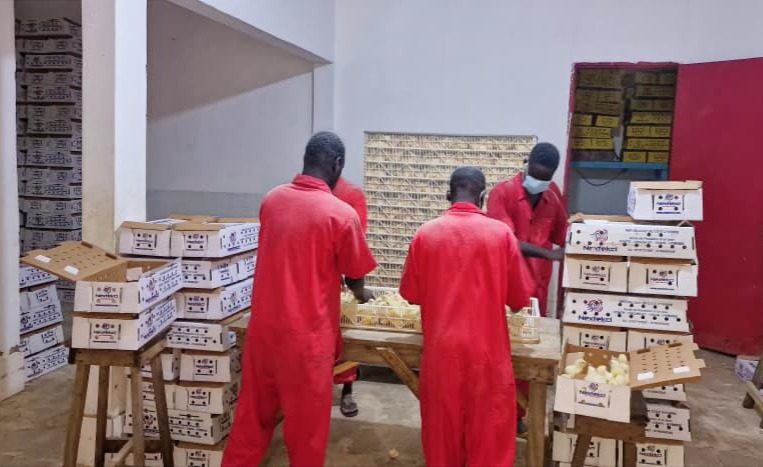
Many poultry entrepreneurs do not live on their farm. The farm is then only as good as its team: its instructions, its checks and its motivation. The method is simple: written roles, regular checks that are the same for everyone, and a bonus based on results the employee can control.
Clear roles
| Role | Responsible for | Benchmark |
|---|---|---|
| Farm manager or stockman | Running the flock, daily record sheet, health, calling the vet, feed stock | Present at brooding and at key moments |
| Farm worker | Water, feed, litter, removing dead birds, cleaning, curtains | One per 2,000 to 3,000 broilers; more for layers |
| Night cover | Heat and chick distribution at brooding, security, alerts | Essential for the first nights and against theft |
| Owner | Decisions, purchases, sales, cash, weekly check | Present at the sale weighing and the bag count |
Benchmarks: NEXTEKCI School lessons, levels 2, 4 and 5
Checks that protect everyone
- Counting the bags every week: this is check number one, because feed is the farm’s money.
- Counting the birds at arrival, at each culling and at sale: “missing” birds with no recorded deaths are a warning sign.
- The record sheet checked every week, with a walk round the house.
- A visit at an unexpected time, now and then.
- A farm WhatsApp group: every day a photo of the record sheet and of the flock, every week the average weight.
Benchmarks: NEXTEKCI School lessons, levels 2, 4 and 5
Pay, motivate, train
- A fair wage, paid on the agreed date, without exception.
- An end-of-flock bonus based on figures the employee controls (mortality, FCR, house ready on time), calculated in front of them with the record sheet. Never on the selling price, which they do not control.
- One day off a week, organised with a replacement, and decent housing if they live on site.
- An emergency budget (gas, vet) with receipts, so that they can save the flock at 2 in the morning without waiting for your approval.
- Training: the NEXTEKCI School is free and awards a certificate for each level.
Benchmarks: NEXTEKCI School lessons, levels 2, 4 and 5
When a figure does not add up, look for the cause together before accusing anyone: writing mistakes are common. And the rules apply to everyone, including family and yourself: an owner who walks in wearing town shoes cancels all the instructions.
9. Buying and selling
A good farmer can lose at buying or selling what was earned in the house. Buying well means paying for quality and consistency, not just the price. Selling well means choosing your buyers, your selling method and your timing, and keeping your commitments.
Buying well
- Chicks: an approved hatchery, a pre-order at least 15 days ahead, an arrival date set for when the house is ready, chicks counted and checked on arrival.
- Feed: a regular supplier, intact and dated bags, a few bags weighed on delivery, a sample kept from each delivery.
- Change feed supplier only after two flocks in a row with problems written on the record sheet, never on the promise of a lower price.
- Equipment: several quotes, and strength before price; a leaking drinker wets the litter for the whole flock.
- Keep all invoices: they make up the flock account and the financing file.
Benchmarks: NEXTEKCI School lessons, levels 2, 4 and 5
Per bird or per kilo?
| Selling method | Advantage | Choose it when |
|---|---|---|
| Per kilo | Fair to both sides, rewards weight | The flock is heavy and even; reliable scales are available |
| Per bird | Simple and quick | The flock is light or uneven: sell by category (large, medium, small) |
Benchmarks: NEXTEKCI School lessons, levels 2, 4 and 5
What a written sales agreement should state
- The number of birds, the type and the expected average weight.
- The date and time of collection, and who transports.
- The selling method (per bird or per kilo) and the price, or how it will be calculated.
- Weighing: in front of both parties, scales checked, empty crates weighed separately to deduct their weight.
- Payment: a deposit for large quantities, the balance before or at loading, a signed receipt.
- Health conditions: 8 to 12 hours of feed withdrawal before slaughter, withdrawal periods of treatments respected.
Keeping your buyers
- Two or three different buyers, so you never depend on a single one.
- A buyers’ book: name, phone, what they take, how they pay, how the last sale went.
- A message one week before the sale: photo of the flock, weighed average weight, number available, date.
- No credit without a track record. An unpaid sale costs more than a slightly cheaper one.
- The whole flock sold within one to two weeks; the buyer is found before the chicks are ordered.
- Keep your word on date, number and weight: a buyer who is well served comes back and brings others.
Benchmarks: NEXTEKCI School lessons, levels 2, 4 and 5
Keep your cost per kilo in mind during every negotiation. Below it, you refuse or change buyer: selling at a loss to “empty the house” is only justified if keeping the birds would cost even more in feed.
10. Financing your farm
A farm needs money at two moments: to build and equip (the investment), and to run each flock until it is sold (working capital). The two are not financed in the same way. The golden rule: a long-lasting asset is financed over the long term. A house that lasts ten years is not paid for with a six-month loan.
The steps of a well-financed project
- 1Work out the total from quotes: house, equipment, working capital (the chicks, all the feed for the first flock, wages and energy until the first sale) and a contingency margin of 10 to 15%.
- 2Calculate the expected yearly margin: net margin per flock in the middle scenario × number of flocks per year.
- 3Calculate the payback period: total cost ÷ yearly margin, in years. Benchmark: 3 to 4 years in the middle scenario is a good project; beyond 6 to 7 years, the project waits.
- 4Check the rest: a buyer who can take the extra production, a team to run the house, enough water, cash for all the flocks running in parallel.
- 5Choose a source of finance whose term matches the life of what is being financed.
- 6Prepare the file, then start small if necessary: the house can be built in several stages, at the pace of the flocks.
Benchmarks: NEXTEKCI School lessons, levels 2, 4 and 5
Sources of finance
| Source | What for | Watch out |
|---|---|---|
| Reinvested profits | The safest: grow step by step | Slower, but no interest and no repayment risk |
| Bank (investment loan) | House and equipment, over several years | Complete file, collateral required, loan term at least equal to the payback period |
| Microfinance, cooperative, savings group (tontine) | Small equipment, working capital | Terms often short: never for a house |
| Supplier credit | Feed for one flock | Obtained with a track record; costly if not honoured |
| Programmes and support (State, FIRCA, projects, IPRAVI interprofession) | Equipment, training, sometimes grants | Delays and paperwork: find out early, do not build the project on it |
| Investor partner | Capital in exchange for a share of profits | Written contract, clear roles, planned exit |
Benchmarks: NEXTEKCI School lessons, levels 2, 4 and 5
The file that convinces
- Three flock summaries with their daily record sheets.
- Up-to-date registers (feed, health, sales, cash).
- Quotes for the house and the equipment.
- The flock rotation calendar.
- The payback period calculated in the three scenarios.
- One page on your buyers, and your team’s training certificates.
Benchmarks: NEXTEKCI School lessons, levels 2, 4 and 5
A bank does not lend to an idea, it lends to proven figures. A farmer who has kept records and flock summaries for a year already has half of the file. And the monthly repayment must be affordable in the middle scenario, not only in the best one.
11. The mistakes that ruin a farm
Farms that close have rarely had a single big problem. More often they have built up several management mistakes, each one “small”, whose effects add up flock after flock.
Mistakes and their remedies
| Mistake | What happens | The remedy |
|---|---|---|
| Starting a flock with no buyer | The birds stay, eat, and are sold off cheaply | Find two or three buyers before ordering the chicks |
| Starting without the money for all the feed | Rationed feed or selling too early, a failed flock | Working capital in hand before ordering |
| Forgetting fixed costs and your own work | A margin that looks good, a house that cannot be replaced | Calculate the net margin, depreciation included |
| Financing a house with a short loan | Repayments impossible to meet | A long-lasting asset is financed over the long term |
| Keeping no records | No way of knowing what worked and what did not | Daily record sheet and a one-page summary for each flock |
| Mixing the farm’s cash with the household’s | The feed money disappears into family spending | A separate cash book or account for the farm |
| Too many birds in the house | Heat, mortality, uneven flock | Respect stocking density; reduce it after a flock hit by heat |
| Skipping downtime | Diseases come back flock after flock | All in, all out, with a real downtime period |
| Selling too late | FCR worsens, each kilo costs more | Sell at the right age, prepared a week ahead |
| Giving credit without a track record | Income never received | Deposit, payment at loading, credit only to known buyers |
| Depending on a single buyer | Price imposed, sales blocked if they pull out | Two or three different buyers |
| Buying the cheapest feed without looking at results | Worse FCR: the saving disappears | Judge a feed on FCR and cost per kilo, over two flocks |
| Treating without a vet | Useless products, poorly treated diseases, withdrawal periods ignored | Diagnosis and treatment by the vet in your area |
| Growing too fast | Cash and team overwhelmed | Three profitable flocks, a buyer, cash and a team before adding a house |
Benchmarks: NEXTEKCI School lessons, levels 2, 4 and 5
Rules to write down while all is well
- Sell earlier than planned if mortality exceeds your threshold despite the vet, or if cash no longer covers the feed.
- Reduce stocking density for the next flock after heat mortality or uniformity below 70%.
- Add a house only after three flocks in a row with a positive net margin.
- Take a break after two flocks in a row at a loss with no cause corrected: understanding is better than a third loss.
Benchmarks: NEXTEKCI School lessons, levels 2, 4 and 5
Decisions made under stress are poor decisions. Write your decision rules on a day when all is well, put them up in the store, and apply them on the day things go wrong.
12. The monthly dashboard
The dashboard holds the farm on one page. The stockman fills it in, the owner reads it on the same day every month (and the flock indicators every week). Read the colours before the figures: green, orange, red. Every red box calls for a decision.
The lines of the dashboard
| Indicator | Calculation | Target | Red flag |
|---|---|---|---|
| Cumulative mortality per flock | (Dead + culled) ÷ received × 100 | Within the School’s benchmarks | Vet call thresholds crossed |
| Average weight compared with target | Weighing ÷ target weight for the week | Gap below 5% | Gap above 10% |
| Uniformity | Share of birds within plus or minus 10% of the average | 70% or more | Below 70% |
| FCR, estimated then actual | Cumulative feed ÷ live weight | Your best flock | Above the previous flock |
| Laying rate (layers) | Eggs of the day ÷ hens present × 100 | The strain’s curve | Sudden drop from one week to the next |
| Cost per kilo or per egg | Costs ÷ kilos or eggs sold | Falling or stable | Above the average selling price |
| Net margin per flock and per m² | Flock summary ÷ usable floor area | Positive and stable | Negative or falling two flocks in a row |
| House occupancy rate | Days occupied ÷ days in the month × 100 | High, with downtime built into the plan | House empty for no reason |
| Cash | Money available ÷ daily feed cost of all flocks | Until the next sale | Less than two weeks of feed covered |
| Money owed by buyers | Total of unpaid sales | Close to zero | Rising from one month to the next |
| Feed stock | Stock counted ÷ daily consumption | Enough until the next delivery | Gap between record sheet and count |
Benchmarks: NEXTEKCI School lessons, levels 2, 4 and 5
The monthly routine
- 1Gather the record sheets of each house, the feed register, the cash book and the sales sheets.
- 2Fill in the dashboard, house by house, then the line for the whole site.
- 3Colour each box: green, orange or red, compared with the target.
- 4For each red box, look for the cause on the record sheet, with the stockman.
- 5Decide on one action per house, write it down, and check its effect the following month.
- 6File the dashboard with the previous ones: twelve months of dashboards are worth a bank file.
Benchmarks: NEXTEKCI School lessons, levels 2, 4 and 5
The format matters more than the tool: a ruled exercise book, a spreadsheet or a structured WhatsApp message will do, as long as they are the same every month. It is the comparison with the previous month that brings problems to light.
Need advice?
Our advisers answer on WhatsApp: +225 05 44 83 27 79 (information) · +225 07 07 72 78 67 (chick orders).