
Field exercise: calculate daily gain, feed conversion and uniformity on your last flock
Until now, the figures were those of the lesson. This time, they are yours. You are going to open the record book of your last flock (or of the current flock), gather five pieces of data, work through four calculations and fill in a one-page sheet. In two hours, you will have the complete flock line of your farm, the one a technician presents to their owner. And if a piece of data is missing, you will have found your first job: making it available for the next flock.
12 min read · 20-question assignment at the end (16 to pass)
 By Abdul Hussein ChoumanFounder of NEXTEKCI · Agnibilékrou hatchery since 2006
This lesson is part of Level 10 — Technical analysis and management. It opens to registered students who have passed the level 9 exam. Levels 1 to 5 remain readable by everyone.
Until now, the figures were those of the lesson. This time, they are yours. You are going to open the record book of your last flock (or of the current flock), gather five pieces of data, work through four calculations and fill in a one-page sheet. In two hours, you will have the complete flock line of your farm, the one a technician presents to their owner. And if a piece of data is missing, you will have found your first job: making it available for the next flock.
- ✓Gather the five pieces of data needed from the record book, delivery notes and sales slips
- ✓Calculate livability, average weight, daily gain, feed conversion and efficiency index on your own flock
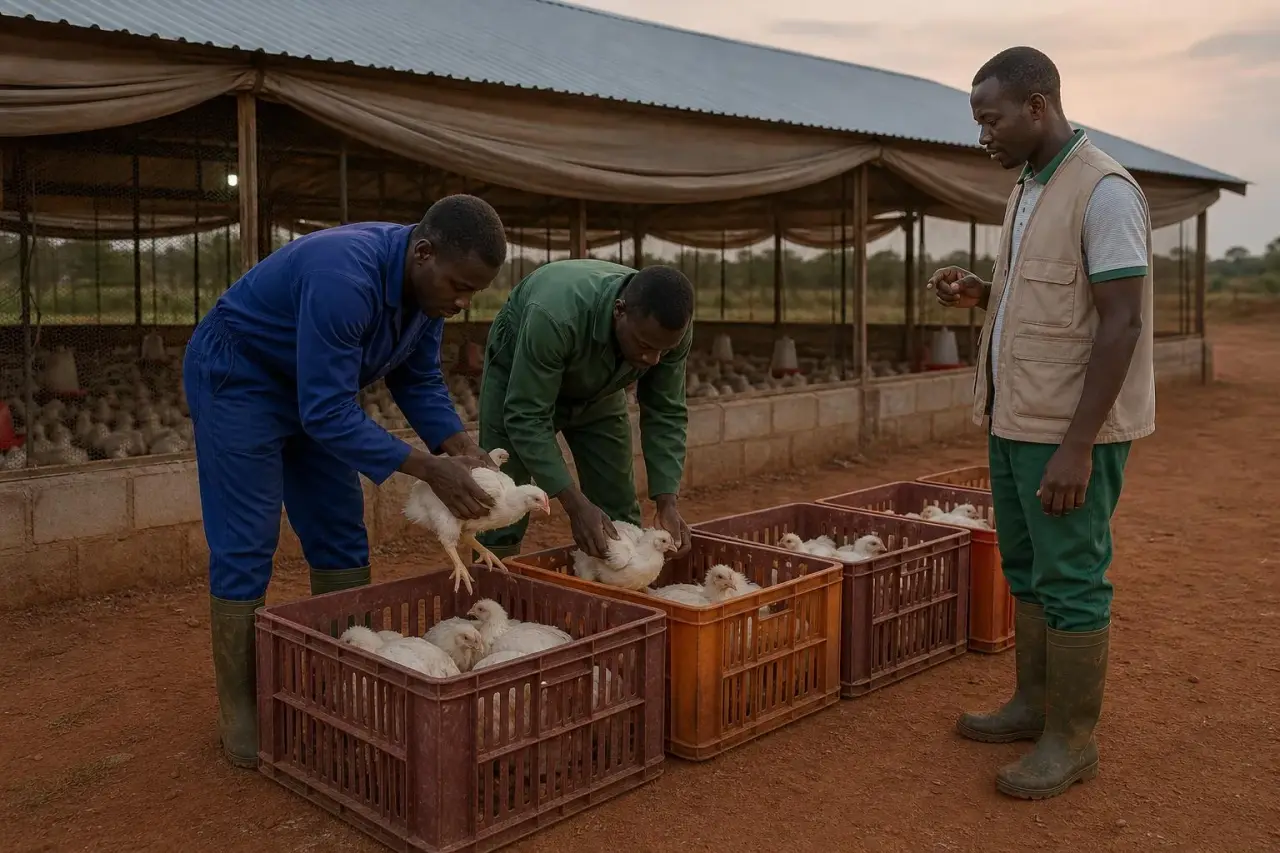
- ✓Carry out a weighing of 50 birds on the current flock and derive uniformity and coefficient of variation
- ✓Fill in the flock sheet and read it with the grids of the level
- Equipment and data to gather
- Step 1: flock size and livability
- Step 2: average weight and daily gain
- Step 3: feed conversion and efficiency index
- Step 4: the uniformity weighing on the current flock
- The sheet to fill in and how to read it
- Going further
- •Five pieces of data: received, sold, kilos sold, age at sale, total feed; plus the chick weight. Everything else is calculated.
- •Livability = S ÷ R × 100; average weight = K ÷ S; DWG = (average weight − W0) ÷ D; FCR = F ÷ K; EPEF = (liv. × weight kg) ÷ (D × FCR) × 100.
- •Age at sale over several departures: average weighted by numbers; round at the end, never in the middle.
- •Weighing of 50 birds: three spots, pen, all weighed; ± 10% uniformity and CV by the range (÷ 4.5 for 50 birds) or in the spreadsheet.
- •Every "estimated" piece of data is the first job of the next flock; without kilos weighed at sale, no management.
© NEXTEKCI, Agnibilékrou · Lessons protected by copyright · Terms of use · Privacy policy