
Field exercise: time the breathing and observe the posture of 10 birds in the hot hours
Everything you have learnt in this level fits into a ten-minute action: counting the breathing and recording the posture of ten birds, at the hottest hour, and comparing with the same measurement taken in the cool of the morning. This exercise gives you the first physiological figure of your farm, the one that warns of heat stroke before the deaths. You will do it three days in a row, on your own house, with the sheet provided, and you will know how to read the result.
14 min read · 20-question assignment at the end (16 to pass)
 By Abdul Hussein ChoumanFounder of NEXTEKCI · Agnibilékrou hatchery since 2006
This lesson is part of Level 6 — The bird: anatomy, physiology, behaviour. It opens to registered students who have passed the level 5 exam. Levels 1 to 5 remain readable by everyone.
Everything you have learnt in this level fits into a ten-minute action: counting the breathing and recording the posture of ten birds, at the hottest hour, and comparing with the same measurement taken in the cool of the morning. This exercise gives you the first physiological figure of your farm, the one that warns of heat stroke before the deaths. You will do it three days in a row, on your own house, with the sheet provided, and you will know how to read the result.
- ✓Prepare the equipment and choose ten representative birds without disturbing the flock
- ✓Count a reliable breathing rate (15 seconds × 4) and code the posture with a four-sign grid
- ✓Fill in the record sheet, calculate the average, the maximum and the percentage of open beaks, and compare morning and afternoon
- ✓Read the result with the thresholds and decide the day's action
- Why this exercise, and what it measures
- Equipment and preparation
- The steps, one by one
- The sheet to fill in
- Reading the result and deciding
- Going further
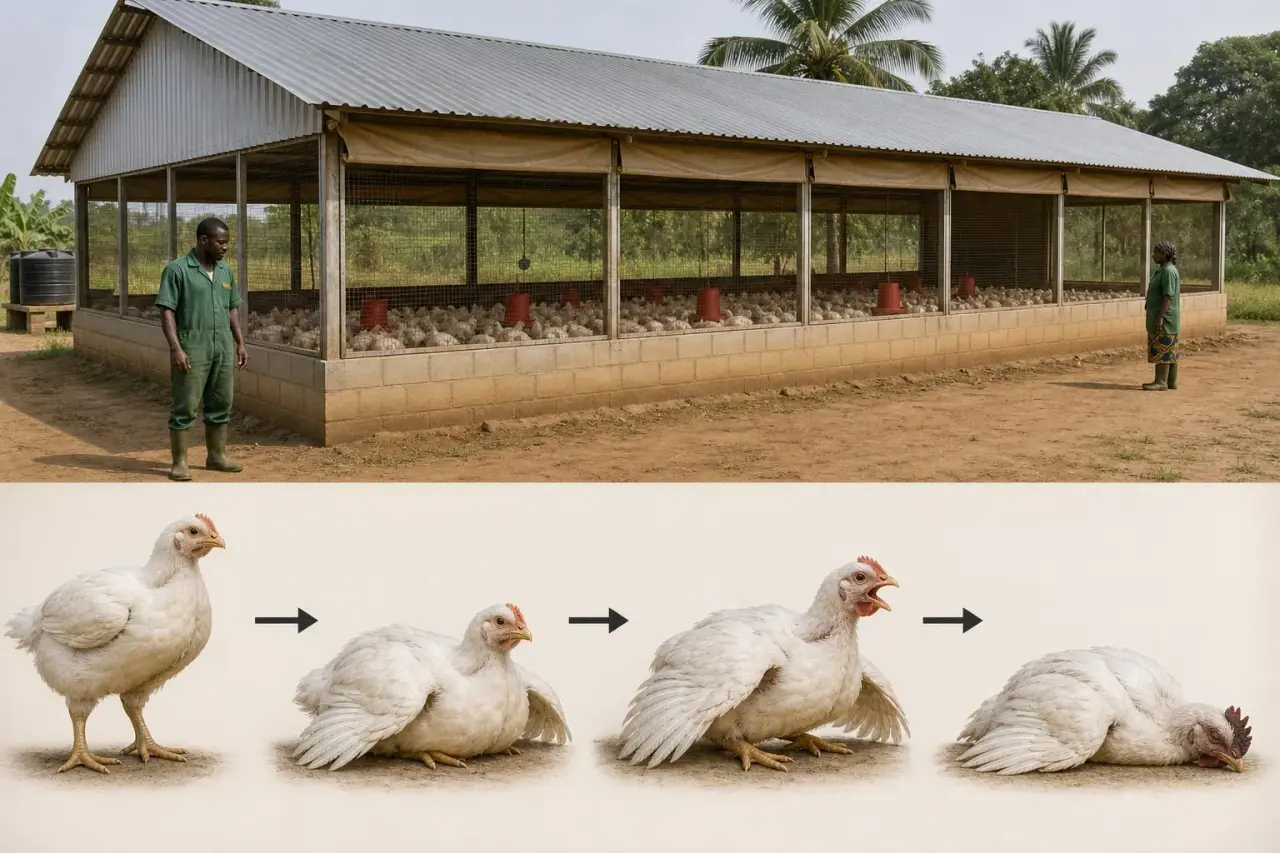
- •10 birds in 3 zones (3 + 4 + 3), neither the bold nor the fleeing ones, of varied sizes; 15 seconds × 4, never an estimate, never a bird that has just moved.
- •Posture coded in 4 signs: B beak open, A wings spread, C lying flat, P prostrate or purplish comb.
- •Calculations: average, maximum, % of open beaks, average by zone; cost of the afternoon = 2 p.m. average − 6.30 a.m. average.
- •Reading: under 60 copes; 60 to 100 or 20 to 50% of B = act within the hour; above 100, more than 50% of B or one P = emergency; morning above 50 = air or health, not heat.
- •Three days of records, two times a day, sheets kept: the next flock at the same age will say whether the corrections have worked.
© NEXTEKCI, Agnibilékrou · Lessons protected by copyright · Terms of use · Privacy policy